| ![Show Contents]() Netting History, Family Crest & Coats of Arms Netting History, Family Crest & Coats of Arms
Etymology of NettingWhat does the name Netting mean? The ancestors of the Netting family were part of an ancient Scottish tribe called the Picts. The name Netting is derived from the Pictish name Nechtan. The Gaelic form of the name is Mac Neachdainn, which means son of Nechtan. Early Origins of the Netting familyThe surname Netting was first found in Argyllshire (Gaelic erra Ghaidheal), the region of western Scotland corresponding roughly with the ancient Kingdom of Dál Riata, in the Strathclyde region of Scotland, now part of the Council Area of Argyll and Bute, where they held lands at Lochow and Loch Fyne, called Glenera, Glenshira, and Glen Fyne. Early History of the Netting familyThis web page shows only a small excerpt of our Netting research. Another 193 words (14 lines of text) covering the years 1247, 1431, 1438, 1565, 1614, 1627 and 1691 are included under the topic Early Netting History in all our PDF Extended History products and printed products wherever possible. Netting Spelling VariationsThe appearance of the printing press and the first dictionaries in the last few hundred years did much to standardize spelling. Prior to that time scribes spelled according to sound, a practice that resulted in many spelling variations. Netting has been spelled MacNaughton, McNachton, MacNaghten, MacNechten, Notton, Norton and many more. Early Notables of the Netting familyMore information is included under the topic Early Netting Notables in all our PDF Extended History products and printed products wherever possible. Migration of the Netting family to IrelandSome of the Netting family moved to Ireland, but this topic is not covered in this excerpt. More information about their life in Ireland is included in all our PDF Extended History products and printed products wherever possible.
| Netting migration to the United States | + |
The expense of the crossing to the North American colonies seemed small beside the difficulties of remaining in Scotland. It was a long and hard trip, but at its end lay the reward of freedom. Some Scots remained faithful to England and called themselves United Empire Loyalists, while others fought in the American War of Independence. Much of this lost Scottish heritage has been recovered in the last century through Clan societies and other patriotic Scottish organizations. A search of immigration and passenger lists revealed many important, early immigrants to North America bearing the name of Netting:
Netting Settlers in United States in the 19th Century- C Netting, who arrived in San Francisco, California in 1851 1
| Netting migration to Australia | + |
Netting Settlers in Australia in the 19th Century- Isaac Netting, aged 33, a blacksmith, who arrived in South Australia in 1854 aboard the ship "Trafalgar" 2
- Mr. Charles Netting, (b. 1871), aged 19, Cornish settler travelling aboard the ship "Taroba" arriving in Queensland, Australia on 5th December 1890 3
| Contemporary Notables of the name Netting (post 1700) | + |
- Rosalind B. Netting, American Republican politician, Candidate in primary for Michigan State Senate 4th District, 1930 4
- Ralph B. Netting (1897-1985), American politician, Mayor of Grosse Pointe, Michigan, 1945-53 5
- Conrad J. Netting (1868-1947), American Republican politician, Member of Michigan State House of Representatives from Wayne County 1st District, 1925-32; Defeated, 1932, 1934, 1936, 1938, 1940, 1942 5
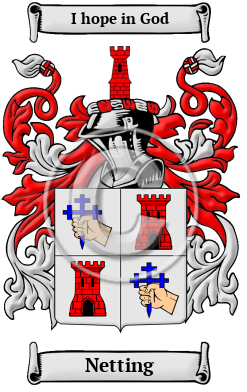
The motto was originally a war cry or slogan. Mottoes first began to be shown with arms in the 14th and 15th centuries, but were not in general use until the 17th century. Thus the oldest coats of arms generally do not include a motto. Mottoes seldom form part of the grant of arms: Under most heraldic authorities, a motto is an optional component of the coat of arms, and can be added to or changed at will; many families have chosen not to display a motto.
Motto: I hope in God
- Filby, P. William, Meyer, Mary K., Passenger and immigration lists index : a guide to published arrival records of about 500,000 passengers who came to the United States and Canada in the seventeenth, eighteenth, and nineteenth centuries. 1982-1985 Cumulated Supplements in Four Volumes Detroit, Mich. : Gale Research Co., 1985, Print (ISBN 0-8103-1795-8)
- South Australian Register Thursday 29th June 1854. (Retrieved 2010, November 5) Trafalgar 1854. Retrieved http://www.theshipslist.com/ships/australia/trafalgar1854.shtml
- Cornwall Online Parish Clerks. (Retreived 3rd May 2018). Retrieved from http://www.opc-cornwall.org/Resc/pdfs/emigration_australia_queensland.pdf
- The Political Graveyard: Alphabetical Name Index. (Retrieved 2016, January 18) . Retrieved from http://politicalgraveyard.com/alpha/index.html
 |