| ![Show Contents]() Munser History, Family Crest & Coats of Arms Munser History, Family Crest & Coats of Arms
Etymology of MunserWhat does the name Munser mean? Munser is a name of ancient Norman origin. It arrived in England with the Norman Conquest of 1066. The Munser family lived in Kent. The name, however, is a reference to the family's place of residence prior to the Norman Conquest of England in 1066, Moion, near St. Lo, Normandy, "where the site of their castle is still to be seen. Wace tells us that 'old William de Moion had with him many companions' and the battle of Hastings, and one of Leland's rolls of the Norman conquerors is nothing but a list of those who came in the train of 'Monseir William de Moion le Veil, le plus noble de tout l'ouste." 1 Early Origins of the Munser familyThe surname Munser was first found in Kent where they held a family seat at Maidstone in that shire. They were descended from Guillaume (William) de Moyon a Norman Baron whose seat was at the castle of Moion, near St. Lo in Normandy. 2 William de Moyon received large grants of land in Somerset, the Lordship of Clehangre in Devon, and Sutton in Wiltshire. He also had grants in Kent. From William was descended the first Earl of Somerset, the Earls of Dorset and the Barons of Okehampton. "At the period of the Conquest, this town [now called Minehead], then called Manheved, was given by William [the Conqueror] to William de Mohun." 3 Although the main stem of this very noble Norman family retained the various spellings of Munn or Munns, junior lines adopted the name Munson or Munnings. The same William de Mohun (Moyon) held estates in Dunster, Somerset. "The town, which is called Torre in Domesday Book, owes its origin to a baronial castle built here by William de Mohun, a Norman Baron, on whom the Conqueror had bestowed large estates in this part of the kingdom. The castle, which was held by the family of Mohun till the reign of Edward III., was the scene of hostilities in the civil wars of the reigns of Stephen and John, and in the contests between the houses of York and Lancaster; the Marquess of Hertford, also, took possession of it for Charles I. during the war with the parliament." 3 "Rosteage, [in the parish of Gerrans, Cornwall] in the reign of Elizabeth, was the seat of Reginald Mohun, a captain under Sir Walter Raleigh. In this family it continued until the year 1662, when it was purchased by Nicholas Kempe, Esq." 4 Early History of the Munser familyThis web page shows only a small excerpt of our Munser research. Another 260 words (19 lines of text) covering the years 1390, 1400, 1508, 1510, 1537, 1564, 1568, 1571, 1573, 1579, 1587, 1595, 1603, 1606, 1608, 1610, 1613, 1615, 1616, 1618, 1620, 1625, 1626, 1629, 1641, 1642, 1645, 1665, 1681, 1684, 1685, 1689, 1690, 1692, 1712, 1718 and 1890 are included under the topic Early Munser History in all our PDF Extended History products and printed products wherever possible. Munser Spelling VariationsEndless spelling variations are a prevailing characteristic of Norman surnames. Old and Middle English lacked any definite spelling rules, and the introduction of Norman French added an unfamiliar ingredient to the English linguistic stew. French and Latin, the languages of the court, also influenced spellings. Finally, Medieval scribes generally spelled words according to how they sounded, so one person was often referred to by different spellings in different documents. The name has been spelled Moyon, Moion, Mohun, Moyne, Munn, Munns, Munson, Munton, Mwn, Mun, Munds, Mouns, Muns, Munnes, Munnson, Munnsen, Munning and many more. Early Notables of the Munser familySir Reginald Mohun, 1st Baronet (ca.1603-1642), an English politician who sat in the House of Commons in 1625 and 1626; John Mohun, 1st Baron Mohun of Okehampton (1595-1641), an English politician; Warwick Mohun, 2nd Baron Mohun of Okehampton (1620-1665), an English politician; Michael Mohun (1616?-1684), a leading British actor, he began his stage career as a young boy filling female roles eventually becoming...
Another 62 words (4 lines of text) are included under the topic Early Munser Notables in all our PDF Extended History products and printed products wherever possible. Migration of the Munser family to IrelandSome of the Munser family moved to Ireland, but this topic is not covered in this excerpt.
Another 99 words (7 lines of text) about their life in Ireland is included in all our PDF Extended History products and printed products wherever possible.
| Munser migration to Australia | + |
Emigration to Australia included the Second Fleet of convicts, tradespeople and early settlers. Early immigrants include: Second Fleet - Mr. Thomas Munser, British settler convicted in Hertfordshire, England in 1788, sentenced to 7 years for stealing, transported aboard the ship "Admiral Barrington" leaving in 1790 arriving in New South Wales, Australia in 1791 5
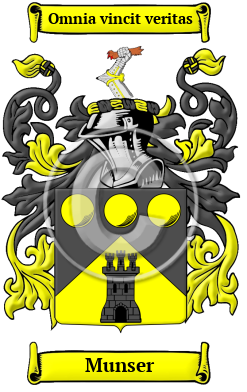
The motto was originally a war cry or slogan. Mottoes first began to be shown with arms in the 14th and 15th centuries, but were not in general use until the 17th century. Thus the oldest coats of arms generally do not include a motto. Mottoes seldom form part of the grant of arms: Under most heraldic authorities, a motto is an optional component of the coat of arms, and can be added to or changed at will; many families have chosen not to display a motto.
Motto: Omnia vincit veritas
Motto Translation: Truth conquers all things.
- Cleveland, Dutchess of The Battle Abbey Roll with some Account of the Norman Lineages. London: John Murray, Abermarle Street, 1889. Print. Volume 2 of 3
- Lower, Mark Anthony, Patronymica Britannica, A Dictionary of Family Names of the United Kingdom. London: John Russel Smith, 1860. Print.
- Lewis, Samuel, A Topographical Dictionary of England. Institute of Historical Research, 1848, Print.
- Hutchins, Fortescue, The History of Cornwall, from the Earliest Records and Traditions to the Present Time. London: William Penaluna, 1824. Print
- Convict Records of Australia. Retrieved 4th February 2021 from https://convictrecords.com.au/ships
 |