| ![Show Contents]() Mulconry History, Family Crest & Coats of Arms Mulconry History, Family Crest & Coats of Arms
- Origins Available:
Ireland
Etymology of MulconryWhat does the name Mulconry mean? The name Mulconry has changed considerably in the time that has passed since its genesis. It originally appeared in Gaelic as Ó Maolconaire, denoting a descendant of the follower of Conaire. However, this was not the only Gaelic name Anglicized Conroy; others were Ó Conraoi, Mac Conraoi, Ó Conaire, and Ó Conratha. 1 Early Origins of the Mulconry familyThe surname Mulconry was first found in around Galway Bay, where counties Galway and Clare meet. The Conroys first settled in Lough Corrib and Lough Lurgan, the ancient names of two lakes which now constitute Galway Bay. In modern times, Conrys are also common in Leix and Offaly. There were several different septs whose Gaelic names were Anglicized as Conroy, the most important of which was Ó Maolconaire. They held a family seat in the parish of Clooncraff, near Strokestown in the county of Roscommon. They used the Anglicized form O'Mulconry, which was later shortened to Conry, and were distinguished as hereditary poets and historians to the kings of Connacht. One of the most significant members of this sept was Fearfasa O'Mulconry, who, with three of the O'Clerys, compiled the "Annals of the Four Masters" in 1636. Also belonging to this sept was Maurice O'Mulconry, who completed a magnificent copy of the Book of Fenagh in 1517. Other septs who took the name Conroy included the O Conraoisept of Ui Maine, occupying territory in east Galway and south Roscommon, and also the Mac Conraoisept of Moycullen, who were found near the lakes of Lough Corrib and Lough Lurgan, now the Bay of Galway. The surname King was often erroneously used during the late 17th and 18th century as an Anglicized form of several of these names, due to the similarity in sound between them and the Gaelic words Mac an Righ, which means 'son of the King.' This was particularly true among the MacConroys of Moycullen, who changed the name of their ancestral seat from Ballymaconry to Kingstown. Early History of the Mulconry familyThis web page shows only a small excerpt of our Mulconry research. Another 188 words (13 lines of text) covering the years 1172, 1560, 1561, 1616, 1620, 1629, 1641 and 1686 are included under the topic Early Mulconry History in all our PDF Extended History products and printed products wherever possible. Mulconry Spelling VariationsNumerous spelling variations of the surname Mulconry exist. A partial explanation for these variants is that ancient scribes and church officials recorded names as they were pronounced, often resulting in a single person being recorded under several different spellings. Different spellings that were found include Conroy, Conry, Conray, Conrey, O'Conroy, O'Conry, Connery, Conneray, Conneroy, Connroy, Connry and many more. Early Notables of the Mulconry family- Fearfeasa O'Mulconry (O'Maelchonaire,) (fl. 1686), was an Irish chronicler who belonged to a family of the hereditary men of letters in Connaught, where he was born, probably at Cluainnahoidhche, near...
- Flaithrí Ó Maolchonaire (also known as Florence Conry, Conroy, O'Mulconry, Omoelchonry Omulconner) (c.1560-1629), was an Irish Franciscan and theologian, founder of the College of St Anthony of Padua...
| Mulconry migration to Australia | + |
Mulconry Settlers in Australia in the 19th Century- James Mulconry, aged 17, a labourer, who arrived in South Australia in 1858 aboard the ship "Stamboul"
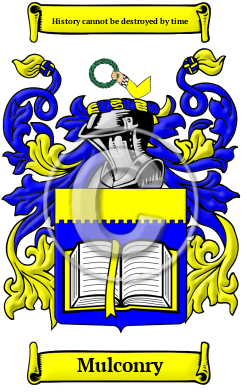
The motto was originally a war cry or slogan. Mottoes first began to be shown with arms in the 14th and 15th centuries, but were not in general use until the 17th century. Thus the oldest coats of arms generally do not include a motto. Mottoes seldom form part of the grant of arms: Under most heraldic authorities, a motto is an optional component of the coat of arms, and can be added to or changed at will; many families have chosen not to display a motto.
Motto: History cannot be destroyed by time
- MacLysaght, Edward, Supplement to Irish Families. Baltimore: Genealogical Book Company, 1964. Print.
 |