
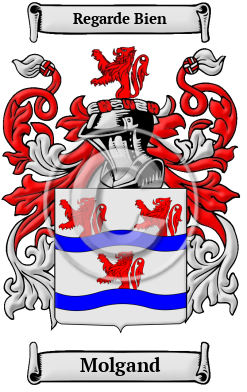
Show ContentsMolgand History, Family Crest & Coats of Arms

Etymology of Molgand

What does the name Molgand mean?

The ancient Scottish name Molgand was first used by the Strathclyde-Briton people of the Scottish/English Borderlands. The original bearer of the name lived in Wigtown, a former royal burgh in the Machars of Galloway in the south west of Scotland. This burgh is first mentioned in an indenture of 1292, and the fact that the sheriffdom was in existence at the time of the Largs campaign of 1263 suggests that the burgh may also have been recognized as such during the reign of Alexander III.

Early Origins of the Molgand family

The surname Molgand was first found in Wigtownshire (Gaelic: Siorrachd Bhaile na h-Uige), formerly a county in southwestern Scotland, now part of the Council Area of Dumfries and Galloway, where they held a family seat from early times and their first records appeared on the early census rolls taken by the early Kings of Scotland to determine the rate of taxation of their subjects.

Early History of the Molgand family

This web page shows only a small excerpt of our Molgand research. Another 131 words (9 lines of text) covering the years 1296, 1526, 1612 and 1688 are included under the topic Early Molgand History in all our PDF Extended History products and printed products wherever possible.

Molgand Spelling Variations

Spelling and translation were hardly exact sciences in Medieval Scotland. Sound, rather than any set of rules, was the basis for spellings, so one name was often spelled different ways even within a single document. Spelling variations are thus an extremely common occurrence in Medieval Scottish names. Molgand has been spelled Milligan, Millicen, Millicken, Milliken, Milligan and many more.

Early Notables of the Molgand family

More information is included under the topic Early Molgand Notables in all our PDF Extended History products and printed products wherever possible.

Migration of the Molgand family to Ireland

Some of the Molgand family moved to Ireland, but this topic is not covered in this excerpt. More information about their life in Ireland is included in all our PDF Extended History products and printed products wherever possible.

Migration of the Molgand family

Such hard times forced many to leave their homeland in search of opportunity across the Atlantic. Many of these families settled along the east coast of North America in communities that would become the backbones of the young nations of the United States and Canada. The ancestors of many of these families have rediscovered their roots in the 20th century through the establishment of Clan societies and other patriotic Scottish organizations. Among them: Jane Mullican, listed in a land patent record in Maryland in 1674; Bryant Milligan, who is on record in Virginia in 1705; Alexander, Edward, Francis, Hugh, James, John, Martin, Samuel, Thomas and William Milligan all arrived in Philadelphia between 1840 and 1860.


The Molgand Motto +

The motto was originally a war cry or slogan. Mottoes first began to be shown with arms in the 14th and 15th centuries, but were not in general use until the 17th century. Thus the oldest coats of arms generally do not include a motto. Mottoes seldom form part of the grant of arms: Under most heraldic authorities, a motto is an optional component of the coat of arms, and can be added to or changed at will; many families have chosen not to display a motto.

Motto: Regarde Bien
Motto Translation: Attend well.


Houseofnames.com on Facebook