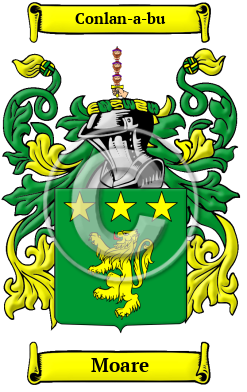
| ![Show Contents]() Moare History, Family Crest & Coats of Arms Moare History, Family Crest & Coats of Arms
- Origins Available:
Ireland
Etymology of MoareWhat does the name Moare mean? There are several distinct sources of the Moare surname in Ireland. Most of the name find their roots with the Anglo-Norman "Strongbow" invasion of the 12th century. Many of these became de Mora. Others derived from the Old Irish "O Mordha," from the word "mordha," meaning "stately," or "noble." 1 The English surname Moare is derived from the personal name "More," which is itself derived from the Old French word "maur," meaning "Moor." Early Origins of the Moare familyThe surname Moare was first found in Munster, where the name was firmly established shortly after the Strongbow invasion of Ireland in 1172. 1 'Aimergin Ua Mordha, A.D. 1026.' O'Mordha is Anglicised O'More and More, which has now usually become Moore, The O'Mores were a powerful sept in Ireland." 2 "Donal Mór (d. 1194), son of Turlough, was the last King of North Munster. " (O'Hart) The Guinness or MacGunness family claim descent from Cionga, son of Rory Mór and had a similar coat of arms complete with a gold lion on a green shield denoting their heritage. Moore or O'Moore were the hereditary Lords of Leix. Of this branch was Charles O'More who had a younger brother named Rory Oge who in 1587 was slain by the English. The Moores of Rahinduffe, Queen's County are a branch of this previous family. Of note was Anthony O'Moore who joined with the O'Neills and defeated the English army in 1598. (O'Hart) Early History of the Moare familyThis web page shows only a small excerpt of our Moare research. Another 124 words (9 lines of text) covering the years 1557, 1600, 1620, 1621, 1627, 1641, 1655, 1700, 1703, 1706, 1729, 1730, 1767, 1791, 1795, 1798, 1799 and 1822 are included under the topic Early Moare History in all our PDF Extended History products and printed products wherever possible. Moare Spelling VariationsNames were simply spelled as they sounded by medieval scribes and church officials. Therefore, during the lifetime of a single person, his name was often spelt in many different ways, explaining the many spelling variations encountered while researching the name Moare. Some of these variations included: Moore, More, Moor, O'More, Moores, Mores, McMore, Moire, Moare, MacMoore, McMoir, Moir, Moors, O'Moore, O'Moire, McMoare, MacMoir, MacMoare, Mooer and many more. Early Notables of the Moare familyRory O'More (d. 1557) and his son Rory Og O'More, who were both Irish leaders in the wars against the English (Tudor) Kings; Rory O'Moore (Roger O'Moore, O'More, Sir Roger Moore) (c.1600-1655), an Irish landowner of ancient lineage, most notable for being one of the four principal organizers of the Irish Rebellion of 1641; Rory "Roger" More (c. 1620-1655), a member of the Leix sept, was...
Another 66 words (5 lines of text) are included under the topic Early Moare Notables in all our PDF Extended History products and printed products wherever possible. Migration of the Moare familyIrish immigration to North American began in the late 18th century as many Irish families desired to own their own land. This pattern of immigration grew slowly yet steadily until the 1840s. At that time, a failed crop and a growing population in Ireland resulted in the Great Potato Famine. Poverty, disease, and starvation ravaged the land. To ease their pain and suffering the Irish often looked upon North America as a solution: hundreds of thousands undertook the voyage. Their arrival meant the growth of industry and commerce for British North America and the United States. For the individual Irishman, it meant survival and hope, and the opportunity for work, freedom, and ownership of land. The early immigration and passenger lists revealed many bearing the name Moare: Miles Moor, who settled in South Carolina in 1716; James Mooers, and his wife Isabel, who came to New Hampshire in 1725; Aaron Moore, who immigrated to Virginia in 1744.
The motto was originally a war cry or slogan. Mottoes first began to be shown with arms in the 14th and 15th centuries, but were not in general use until the 17th century. Thus the oldest coats of arms generally do not include a motto. Mottoes seldom form part of the grant of arms: Under most heraldic authorities, a motto is an optional component of the coat of arms, and can be added to or changed at will; many families have chosen not to display a motto.
Motto: Conlan-a-bu
Motto Translation: Conlan forever.
- MacLysaght, Edward, Irish Families Their Names, Arms and Origins 4th Edition. Dublin: Irish Academic, 1982. Print. (ISBN 0-7165-2364-7)
- Moore, A.W., Manx Names. London: Elliot Stock, 62 Paternoster Row, 1906. Print
 |