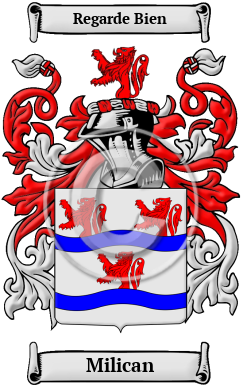
| ![Show Contents]() Milican History, Family Crest & Coats of Arms Milican History, Family Crest & Coats of Arms
- Origins Available:
Ireland
Scotland
Etymology of MilicanWhat does the name Milican mean? The roots of the name Milican are found among the Strathclyde-Briton people of the ancient Scottish/English Borderlands. Milican was originally found in Wigtown, a former royal burgh in the Machars of Galloway in the south west of Scotland. This burgh is first mentioned in an indenture of 1292, and the fact that the sheriffdom was in existence at the time of the Largs campaign of 1263 suggests that the burgh may also have been recognized as such during the reign of Alexander III. Early Origins of the Milican familyThe surname Milican was first found in Wigtownshire (Gaelic: Siorrachd Bhaile na h-Uige), formerly a county in southwestern Scotland, now part of the Council Area of Dumfries and Galloway, where they held a family seat from early times and their first records appeared on the early census rolls taken by the early Kings of Scotland to determine the rate of taxation of their subjects. Early History of the Milican familyThis web page shows only a small excerpt of our Milican research. Another 131 words (9 lines of text) covering the years 1296, 1526, 1612 and 1688 are included under the topic Early Milican History in all our PDF Extended History products and printed products wherever possible. Milican Spelling VariationsIt is only in the last few hundred years that rules have developed and the process of spelling according to sound has been abandoned. Scottish names from before that time tend to appear under many different spelling variations. Milican has been spelled Milligan, Millicen, Millicken, Milliken, Milligan and many more. Early Notables of the Milican familyMore information is included under the topic Early Milican Notables in all our PDF Extended History products and printed products wherever possible. Migration of the Milican family to IrelandSome of the Milican family moved to Ireland, but this topic is not covered in this excerpt. More information about their life in Ireland is included in all our PDF Extended History products and printed products wherever possible.
| Milican migration to Australia | + |
Milican Settlers in Australia in the 19th Century- Mrs. Sarah Milican, (b. 1825), aged 21, English needle woman who was convicted in Ipswich, Suffolk, England for 7 years for stealing, transported aboard the "Elizabeth and Henry" on 14th September 1846, arriving in Tasmania (Van Diemen's Land), she died in 1849 1
- Wesley Milican, aged 23, who arrived in South Australia in 1852 aboard the ship "Medina" 2
| Milican migration to New Zealand | + |
Emigration to New Zealand followed in the footsteps of the European explorers, such as Captain Cook (1769-70): first came sealers, whalers, missionaries, and traders. By 1838, the British New Zealand Company had begun buying land from the Maori tribes, and selling it to settlers, and, after the Treaty of Waitangi in 1840, many British families set out on the arduous six month journey from Britain to Aotearoa to start a new life. Early immigrants include: Milican Settlers in New Zealand in the 19th Century- John Milican a farm labourer, who arrived in Auckland, New Zealand aboard the ship "Sir George Grey" in 1864
The motto was originally a war cry or slogan. Mottoes first began to be shown with arms in the 14th and 15th centuries, but were not in general use until the 17th century. Thus the oldest coats of arms generally do not include a motto. Mottoes seldom form part of the grant of arms: Under most heraldic authorities, a motto is an optional component of the coat of arms, and can be added to or changed at will; many families have chosen not to display a motto.
Motto: Regarde Bien
Motto Translation: Attend well.
- Convict Records Voyages to Australia (Retrieved 13th March 2022). Retrieved from https://convictrecords.com.au/ships/elizabeth-and-henry
- South Australian Register Tuesday 3 February 1852. (Retrieved 2010, November 5) MEDINA 1852. Retrieved http://www.theshipslist.com/ships/australia/medina1852.shtml
 |