| ![Show Contents]() Mewar History, Family Crest & Coats of Arms Mewar History, Family Crest & Coats of Arms
Etymology of MewarWhat does the name Mewar mean? The ancestors of the Mewar family lived among the Strathclyde-Briton people of the Scottish/English Borderlands. Mewar is a name for someone who lived near a moor, or heath. 1 In Gaelic, Mor means great or big; therefore, a scribe may have mistaken the adjective Mor as a surname More or Muir. This may explain the occurrence of the surname Muir, or a variant in Northern Scotland. The name Muir would seem out of place in that region because it holds a meaning of "living by a moor or heath," not the typical landscape of the highlands. Judging by its meaning, Muir is a local name of the south that described the area, in which the original bearer lived or held land. 2 Early Origins of the Mewar familyThe surname Mewar was first found in Ayrshire (Gaelic: Siorrachd Inbhir Àir), formerly a county in the southwestern Strathclyde region of Scotland. Thomas de la More was the executor of the will of Devorguilla de Balliol in 1291. While the first spelling of the name was More, it gradually evolved to Muir which became more popular, and by 1300 the name Muir had become the preferred spelling. Donald, Adam, Renaud, Gilchrist and Simon Muir, all rendered homage on behalf of their Clan to King Edward I of England on his brief conquest of Scotland in 1296. "Adam de la More and William de la More were jurors on the lands of Lady Elena la Zuche in Conyngham, 1296. Ade More who held lands of Reltone in Rerwickshire, in 1315-1321 may be Adam More or Moire, knight, who witnessed charters by Bruce in 1328-1329. Elizabeth Mere, daughter of Sir Adam Mure of Rowallan, became queen of King Robert 11, 1347. Adam of Mwre was juror on inquest in Kirkwall, 1369. John Mvr of Enerothyll was witness, 1460, and John Mur or Muyr was vicar general of the Predicant Order in Scotland, 1469-1470 ." 2 Early History of the Mewar familyThis web page shows only a small excerpt of our Mewar research. Another 178 words (13 lines of text) covering the years 1458, 1526, 1541, 1559, 1594, 1657, 1700, 1740, 1753, 1760, 1765, 1771, 1787, 1793, 1798, 1800, 1810, 1812, 1822, 1829, 1869, 1887, 1890 and 1959 are included under the topic Early Mewar History in all our PDF Extended History products and printed products wherever possible. Mewar Spelling VariationsSpelling and translation were hardly exact sciences in Medieval Scotland. Sound, rather than any set of rules, was the basis for spellings, so one name was often spelled different ways even within a single document. Spelling variations are thus an extremely common occurrence in Medieval Scottish names. Mewar has been spelled Muir, Mure, Moor, Moore, Mure, More, Moorman and many more. Early Notables of the Mewar familySir William Mure (1594-1657), Scottish writer and politician; John Muir, a Sanskrit scholar, and his brother Sir William Muir, who was an Arabic scholar and biographer of Mohammed; and Edwin Muir (1887-1959), a noted poet and critic. Thomas Muir (1765-1798), parliamentary reformer, was born at Glasgow on 24 Aug. 1765, being the only son of Thomas Muir, a flourishing tradesman, who in 1753 published a pamphlet on England's foreign trade. He was educated at Glasgow grammar school and at the university, intending at first to enter the church, but ultimately deciding on the bar, for which he prepared himself under John Millar...
Another 157 words (11 lines of text) are included under the topic Early Mewar Notables in all our PDF Extended History products and printed products wherever possible. Migration of the Mewar family to IrelandSome of the Mewar family moved to Ireland, but this topic is not covered in this excerpt.
Another 83 words (6 lines of text) about their life in Ireland is included in all our PDF Extended History products and printed products wherever possible. Migration of the Mewar familySuch hard times forced many to leave their homeland in search of opportunity across the Atlantic. Many of these families settled along the east coast of North America in communities that would become the backbones of the young nations of the United States and Canada. The ancestors of many of these families have rediscovered their roots in the 20th century through the establishment of Clan societies and other patriotic Scottish organizations. Among them: George Muir (Moore) who was banished to New Jersey from Scotland in 1685; James Muir and his wife and children, who settled in Georgia in 1732; Colin Moore, listed as a Scot banished to the American colonies in 1747.
| Contemporary Notables of the name Mewar (post 1700) | + |
- Arvind Singh Mewar (1944-2025), Indian businessman and chairman of HRH Group of Hotels
- Mahendra Singh Mewar (1941-2024), Indian politician
The motto was originally a war cry or slogan. Mottoes first began to be shown with arms in the 14th and 15th centuries, but were not in general use until the 17th century. Thus the oldest coats of arms generally do not include a motto. Mottoes seldom form part of the grant of arms: Under most heraldic authorities, a motto is an optional component of the coat of arms, and can be added to or changed at will; many families have chosen not to display a motto.
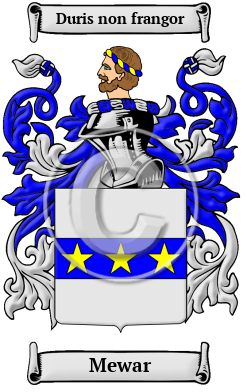
Motto: Duris non frangor
Motto Translation: I am not disheartened by difficulties.
- Lower, Mark Anthony, Patronymica Britannica, A Dictionary of Family Names of the United Kingdom. London: John Russel Smith, 1860. Print.
- Black, George F., The Surnames of Scotland Their Origin, Meaning and History. New York: New York Public Library, 1946. Print. (ISBN 0-87104-172-3)
 |