| ![Show Contents]() Melloy History, Family Crest & Coats of Arms Melloy History, Family Crest & Coats of Arms
- Origins Available:
Ireland
Etymology of MelloyWhat does the name Melloy mean? The Irish name Melloy was originally written in a Gaelic form as Ó Maolmhuaidh, which is derived from the word "muadh," which has the dual meaning of "noble" and "big and soft." 1 The Sept Molloy are the traditional Lords of Fircall, King's County and claim direct "descent from Eochaidh, brother of Tuahal who No. 89 on the 'MacGeoghagens' pedigree, ancestor of O'Maoluaidh, anglicised O'Molloy, and Molloy." (O'Hart) From the Lords, the Molloys of Aghadonoher, King's County and the Molloys of Harperstown and Oakport, County Roscommon descend. (O'Hart) Early Origins of the Melloy familyThe surname Melloy was first found in County Offaly (Irish: Uíbh Fháilí) originally the Kingdom of Uí Failghe, located in central Ireland in the Province of Leinster, where they held a family seat from ancient times. The aforementioned MacGeoghagan who were Lords of Moycassell and Fertullagh, in Westmeath claim descent from Fiach, son of Niall of the Nine Hostages, the 126th Monarch of Ireland who reigned c. 405. He was one of the Heremon Kings of Ireland. (O'Hart) Albin O'Molloy or Alpin O'Moelmhuaidh (d. 1223), was Bishop of Ferns, a native Irishman, "who became a Cistercian monk at Baltinglass, and eventually rose to be abbot of that house. In Lent 1186, when John, archbishop of Dublin, held a synod at Holy Trinity Church, Albin preached a long sermon on clerical continency, in which he laid all the blame for existing evils on the Welsh and English clergy who had come over to Ireland. On 5 Nov. he was appointed by Pope Innocent III, with the Archbishop of Tuam and Bishop of Kilmacduagh, to excommunicate the Bishop of Waterford, who had robbed the Bishop of Lismore." 2 Early History of the Melloy familyThis web page shows only a small excerpt of our Melloy research. Another 149 words (11 lines of text) covering the years 1110, 1640, 1641, 1652, 1660, 1663, 1667, 1669, 1690, 1702, 1742, 1758, 1764 and 1767 are included under the topic Early Melloy History in all our PDF Extended History products and printed products wherever possible. Melloy Spelling VariationsMany spelling variations of the surname Melloy can be found in the archives. One reason for these variations is that ancient scribes and church officials recorded names as they were pronounced, often resulting in a single person being recorded under several different spellings. The different spellings that were found include Molloy, Mulloy, Miley, O'Molloy, O'Mulloy, Mullee and many more. Early Notables of the Melloy familyJohn O'Molloy of English parish, Sugawn chief, Lord of Fercal (Feara Ceall), Offaly
Francis Molloy or O'Maolmhuaidh (fl. 1660), was an Irish theologian and grammarian, a native of the county of Meath, Ireland. "The family of which he was a member had extensive landed possessions in the district known as O'Molloys' Country, and some of them engaged actively in the Irish movements from 1641 to 1652." 2
Charles Molloy (1640-1690), was an Irish lawyer of the Middle Temple, born in County Offaly. He was "a native of King's County and was probably a member of the family of Molloy of Clonbeale, which claims...
Another 154 words (11 lines of text) are included under the topic Early Melloy Notables in all our PDF Extended History products and printed products wherever possible.
| Melloy migration to Australia | + |
Melloy Settlers in Australia in the 19th Century- Mr. Thomas Melloy, (b. 1814), aged 24, English tailor who was convicted in London, England for 15 years for larceny, transported aboard the "Coromandel" on 25th June 1838, arriving in Tasmania (Van Diemen's Land) 3
| Contemporary Notables of the name Melloy (post 1700) | + |
- Michael Joseph Melloy (b. 1948), American jurist, Senior United States circuit judge of the United States Court of Appeals for the Eighth Circuit
- Elaine Elizabeth Melloy (1936-2019), birth name of Elaine Darling, an Australian politician, Member of the Australian Parliament for Lilley (1980-1993)
- John "Jack" Melloy (1908-2006), Australian politician, Deputy Leader of the Opposition in Queensland (1974-1976)
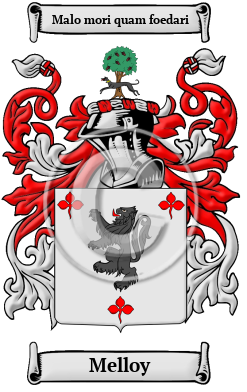
The motto was originally a war cry or slogan. Mottoes first began to be shown with arms in the 14th and 15th centuries, but were not in general use until the 17th century. Thus the oldest coats of arms generally do not include a motto. Mottoes seldom form part of the grant of arms: Under most heraldic authorities, a motto is an optional component of the coat of arms, and can be added to or changed at will; many families have chosen not to display a motto.
Motto: Malo mori quam foedari
Motto Translation: I would rather die than be disgraced.
- MacLysaght, Edward, Supplement to Irish Families. Baltimore: Genealogical Book Company, 1964. Print.
- Smith, George (ed), Dictionary of National Biography. London: Smith, Elder & Co., 1885-1900. Print
- Convict Records Voyages to Australia (Retrieved 19th March 2021). Retrieved from https://convictrecords.com.au/ships/coromandel
 |