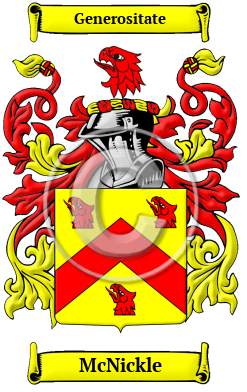
| ![Show Contents]() McNickle History, Family Crest & Coats of Arms McNickle History, Family Crest & Coats of Arms
Etymology of McNickleWhat does the name McNickle mean? The ancient Viking-Scottish name McNickle is derived from from the personal name, Nicholas. McNickle is a patronymic surname, which belongs to the category of hereditary surnames. The surname McNickle arose out of the religious naming tradition. In Christian countries, the name Nicholas was popular, owing to the legends surrounding the 4th century Lycian bishop of that name. In Catholic countries in particular, this religious figure was revered. This accounts for its popularity as a surname in Scotland. The name Nicholas came from the Greek, Nikolaos, which means conqueror of the people. In Scotland, the earliest bearers of the surname McNickle lived on the Isle of Skye, which is located on the western coast. Early Origins of the McNickle familyThe surname McNickle was first found in on the Isle of Skye, where the first on record was Ottar Snaekollson who was the Chief of the MacNichols and attended the Council of Chiefs, held by MacDonald, Lord of the Isles, at Finlaggan on the Island of Islay about 1240. One of the first records of the name in Scotland was Maucolum fiz Nicol, who rendered homage to King Edward I of England in 1296 and the Nicholsons of Skye have Englished their name from Macnicol. 1 Early History of the McNickle familyThis web page shows only a small excerpt of our McNickle research. Another 115 words (8 lines of text) covering the years 1263, 1500, 1607, 1645, 1655, 1694, 1698, 1705, 1713, 1718, 1720, 1725, 1727, 1728 and 1890 are included under the topic Early McNickle History in all our PDF Extended History products and printed products wherever possible. McNickle Spelling VariationsThe spellings of Scottish names dating from the medieval era often bear little resemblance to those seen today. They vary enormously because scribes in that time spelled according to their ears. Some spelling variations of the name McNickle include MacNichol, MacNicol, MacNicoll, Nicolson, Nicholson, MacNicholas, MacNickle, MacNickel, MacNickell, MacNiccol, MacNychole and many more. Early Notables of the McNickle familyJames Nicolson (d. 1607), Moderator of the General Assembly of the Church of Scotland & Bishop of Dunkeld; Thomas Joseph Nicolson (1645-1718), a Roman Catholic bishop, Vicar Apostolic of Scotland (1694-1718); William Nicolson (1655-1727), Bishop of Carlisle; and Sir Francis Nicholson (1655-1728)...
Another 41 words (3 lines of text) are included under the topic Early McNickle Notables in all our PDF Extended History products and printed products wherever possible. Migration of the McNickle family to IrelandSome of the McNickle family moved to Ireland, but this topic is not covered in this excerpt.
Another 105 words (8 lines of text) about their life in Ireland is included in all our PDF Extended History products and printed products wherever possible.
| McNickle migration to the United States | + |
The farms of Scottish settlers soon dotted the east coast of the colonies that would become the nations of the United States and Canada. Many of those migrants and their children went on to play important roles in the founding the great nations of North America. Early North American immigration records have revealed a number of people bearing the Scottish name McNickle or a variant listed above, including:
McNickle Settlers in United States in the 19th Century- George McNickle, who landed in Allegany (Allegheny) County, Pennsylvania in 1838 2
| McNickle migration to Canada | + |
McNickle Settlers in Canada in the 19th Century- Mr. Daniel McNickle, aged 50 who was emigrating through Grosse Isle Quarantine Station, Quebec aboard the ship "Unicorn" departing 23rd May 1847 from Londonderry, Ireland; the ship arrived on 9th July 1847 but he died on board 3
- Mr. Patrick McNickle, aged 40 who was emigrating through Grosse Isle Quarantine Station, Quebec aboard the ship "Broom" departing 13th June 1847 from Liverpool, England; the ship arrived on 6th August 1847 but he died on board 3
| McNickle migration to New Zealand | + |
Emigration to New Zealand followed in the footsteps of the European explorers, such as Captain Cook (1769-70): first came sealers, whalers, missionaries, and traders. By 1838, the British New Zealand Company had begun buying land from the Maori tribes, and selling it to settlers, and, after the Treaty of Waitangi in 1840, many British families set out on the arduous six month journey from Britain to Aotearoa to start a new life. Early immigrants include: McNickle Settlers in New Zealand in the 19th Century- Moses McNickle, aged 21, a ploughman, who arrived in Auckland, New Zealand aboard the ship "Queen of Nations" in 1874
| Historic Events for the McNickle family | + |
USS Indianapolis - Arthur Samuel Mcnickle, American crew member on board the ship "USS Indianapolis" when she was on a top secret trip for the first nuclear weapon, she was sunk by Japanese Navy on 30th July 1945, he was one of the many who were killed in the sinking due to exposure, dehydration, saltwater poisoning and shark attacks 4
The motto was originally a war cry or slogan. Mottoes first began to be shown with arms in the 14th and 15th centuries, but were not in general use until the 17th century. Thus the oldest coats of arms generally do not include a motto. Mottoes seldom form part of the grant of arms: Under most heraldic authorities, a motto is an optional component of the coat of arms, and can be added to or changed at will; many families have chosen not to display a motto.
Motto: Generositate non ferocitate
Motto Translation: Generous not Ferocious
- Black, George F., The Surnames of Scotland Their Origin, Meaning and History. New York: New York Public Library, 1946. Print. (ISBN 0-87104-172-3)
- Filby, P. William, Meyer, Mary K., Passenger and immigration lists index : a guide to published arrival records of about 500,000 passengers who came to the United States and Canada in the seventeenth, eighteenth, and nineteenth centuries. 1982-1985 Cumulated Supplements in Four Volumes Detroit, Mich. : Gale Research Co., 1985, Print (ISBN 0-8103-1795-8)
- Charbonneau, André, and Doris Drolet-Dubé. A Register of Deceased Persons at Sea and on Grosse Île in 1847. The Minister of Canadian Heritage, 1997. ISBN: 0-660-198/1-1997E (p. 89)
- Final Crew List, retrieved 2021, October 30th Retrieved from https://www.ussindianapolis.com/final-crew
 |