| ![Show Contents]() McDowels History, Family Crest & Coats of Arms McDowels History, Family Crest & Coats of Arms
- Origins Available:
Scotland
Ireland
Etymology of McDowelsWhat does the name McDowels mean? The McDowels family name comes from the personal name Dougal. The Gaelic form of the name is Mac Dhughaill and literally means "son of Dougal." The personal name Dougal, meaning "dark stranger." 1 2 "The claim of the Macdowells of Galloway to be descended from the ancient native lords of Galloway can neither be disproved nor can it be satisfactorily established." 3 Early Origins of the McDowels familyThe surname McDowels was first found in South Ayrshire where "Mactheuel witnessed a charter by Uchtredus filius Fergusi of the church of Colmanele (now known as Colmonell) in the reign of Malcolm IV. Fergus McDuhile in Wigton was juror on inquest at Berwick, 1296, and in same year as Fergus MacDowilt rendered homage [to King Edward I of England.] He is probably the Fergus MacDowile who witnessed a charter by William, lord of Douglas, 1306-29 (RHM., l, p. 13). In 1307 a pardon was granted Elyas de Vaus at the request of Duncan MacDuel, and in same year Dungall MacDouyl, senior, for services rendered, requested for his son Dungal, junior, the marriage of the daughter and heiress of Hugh de Champaigne, deceased, a tenant in capite." 3 Early History of the McDowels familyThis web page shows only a small excerpt of our McDowels research. Another 372 words (27 lines of text) covering the years 1268, 1312, 1347, 1354, 1359, 1363, 1390, 1416, 1515, 1578, 1590, 1597, 1602, 1603, 1605, 1609, 1621, 1650, 1653, 1666, 1675, 1677, 1684, 1685, 1690, 1708, 1739, 1743, 1744, 1755, 1760, 1766, 1824 and 1890 are included under the topic Early McDowels History in all our PDF Extended History products and printed products wherever possible. McDowels Spelling VariationsMedieval translation of Gaelic names could not be referred to as an accurate process. Spelling was not yet standardized, and names in documents from that era are riddled with spelling variations. McDowels has been written as MacDowall, MacDowell, MacDugald, MacDill, Dowall, Dowler and many more. Early Notables of the McDowels familyDuncan, Earl of Carrick; Ewen MacDougall (fl. 1268), Lord of Argyll; and Thomas MacDowell, Bishop of Galloway (1359-1363).
William MacDowell (1590-1666), the Scottish diplomatist, born in October 1690 at Makerstoun, Roxburghshire, was son of Thomas Macdowell by Johanna, daughter of Sir Andrew Ker of Greenhead. From 1597 to 1603 he attended Musselburgh school, and in 1605 proceeded to St. Andrews, where he had a distinguished career. King Charles I would have made him a Scottish privy councillor had not the civil war broke out On 4 June 1650. Macdowell became Charles II's resident agent at the Hague. Due to his loyalty to...
Another 255 words (18 lines of text) are included under the topic Early McDowels Notables in all our PDF Extended History products and printed products wherever possible. Migration of the McDowels family to IrelandSome of the McDowels family moved to Ireland, but this topic is not covered in this excerpt.
Another 59 words (4 lines of text) about their life in Ireland is included in all our PDF Extended History products and printed products wherever possible. Migration of the McDowels familyAncestors of many of the Dalriadan families who crossed the Atlantic still live along the east coast of the United States and Canada. Some Scottish settlers arrived in Canada during the American War of Independence as United Empire Loyalists, while others stayed south to fight for a new nation. The descendants of Scottish settlers in both countries began to rediscover their heritage in the 19th and 20th centuries through Clan societies and highland games. An inquiry into the early roots of North American families has revealed a number of immigrants bearing the name McDowels or a variant listed above: Andrew MacDowall and his wife settled in Charles Town [Charleston], South Carolina in 1821; Robert McDowel, who came to Philadelphia in 1740; Samuel McDowel, who settled in Virginia in 1752.
The motto was originally a war cry or slogan. Mottoes first began to be shown with arms in the 14th and 15th centuries, but were not in general use until the 17th century. Thus the oldest coats of arms generally do not include a motto. Mottoes seldom form part of the grant of arms: Under most heraldic authorities, a motto is an optional component of the coat of arms, and can be added to or changed at will; many families have chosen not to display a motto.
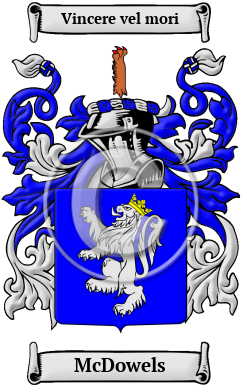
Motto: Vincere vel mori
Motto Translation: Victory
- Arthur, William , An Etymological Dictionary of Family and Christian Names. London: 1857. Print
- Charnock, Richard, Stephen, Ludus Patronymicus of The Etymology of Curious Surnames. London: Trubner & Co., 60 Paternoster Row, 1868. Print.
- Black, George F., The Surnames of Scotland Their Origin, Meaning and History. New York: New York Public Library, 1946. Print. (ISBN 0-87104-172-3)
 |