| ![Show Contents]() McBlain History, Family Crest & Coats of Arms McBlain History, Family Crest & Coats of Arms
Etymology of McBlainWhat does the name McBlain mean? The ancestors of the surname McBlain lived among the Boernicians of the Scottish/English Borderlands. The name comes from the Gaelic personal name Bleen, which means yellow. Saint Blane (Blaan) was "one of the earliest bishops of Kingarth in Bute, is commemorated in the Martyrology of Oengus at August 10: 'With a host, sound, of noble birth, well-coloured, fair Blaan of Kingarth.' His name is from bid, that is yellow, from blavos. He is probably also the saint commemorated in the Calendar of Gorman as Blaan buadach Breton, 'triumphant Blaan of the Britons.' He gave name to Kilblane in Southend, Kintyre, and to Dunblane. According to a Bute legend he was mysteriously begotten of a water-sprite." 1 Early Origins of the McBlain familyThe surname McBlain was first found in Ayrshire and Wigtownshire where the name is a "reduced form of MacBlain." 1 One of the first records of the family was that of "Blahan, presbyter of Litun probably Linton in Roxburghshire witnessed a quitclaim by Robert, Bishop of St. Andrews, 1127." 1 "Patrick Blane was provost of the burgh of Wigtown in 1561, and John Blain had a charter of the half of the ten-mark lands of Meikle-Wig in the parish of Whithorn in 1674. Agnes Blain [was] in the parish of Kirkcudbright, 1684." 1 Across the border in Yorkshire, England Andrew Blayne, Bleyn was listed in the Assize Rolls for 1219 and Nicholas Bleyne Was recorded in the Hundredorum Rolls for Suffolk in 1275. Hamo de Blein was listed in the Curia Regis Rolls for Kent in 1219. Later John Blayne was found in the Feet of Fines for Essex in 1507. Down here, it is thought that the name was derived from the Old Welsh Bledgint, Middle English Blethyn. 2 While the aforementioned early origins are the traditional understandings of the origin of the family, one source claims the name to be "from the town of Blain, in Bretagne, France. Blaen, in the Welsh, signifies the summit or top; the same as pen, brig, and bar, the highest part of a mountain; the end or top of an object; the inland extremity of a glen; a leader or chief." 3 Early History of the McBlain familyThis web page shows only a small excerpt of our McBlain research. Another 104 words (7 lines of text) covering the years 1561, 1660, 1674, 1749, 1750, 1771, 1778, 1780, 1793, 1795, 1834, 1835 and 1890 are included under the topic Early McBlain History in all our PDF Extended History products and printed products wherever possible. McBlain Spelling VariationsBoernician names that evolved in the largely preliterate Middle Ages are often marked by considerable spelling variations. McBlain has been spelled Blain, Blane, Blaine, Blaines, Blahan and others. Early Notables of the McBlain familySir Gilbert Blane (1749-1834), Scottish physician, the fourth son of Mr. Gilbert Blane of Blanefield, Ayrshire, where he was born on 29 Aug. 1749. At the age of fourteen he was sent to the University of Edinburgh, being at first intended for the church, but was ultimately led to study medicine. After spending five years in the faculty of arts, and five more in that of medicine at Edinburgh, he took the degree of M.D. in the university of Glasgow on 28 Aug. 1778. During his studentship he was elected one of the presidents of the (Students') Medical Society of Edinburgh...
Another 155 words (11 lines of text) are included under the topic Early McBlain Notables in all our PDF Extended History products and printed products wherever possible. Migration of the McBlain family to IrelandSome of the McBlain family moved to Ireland, but this topic is not covered in this excerpt.
Another 60 words (4 lines of text) about their life in Ireland is included in all our PDF Extended History products and printed products wherever possible.
| McBlain migration to the United States | + |
Some of the Boernician-Scottish Clan families who came to North America were Loyalists who went north to Canada after the American War of Independence. Families on both sides of the border went on to found two of the world's great nations. This century, families with Scottish roots have rediscovered their heritage through highland games and Clan societies. An inquiry into the early roots of North American families reveals a number of immigrants bearing the name McBlain or a variant listed above:
McBlain Settlers in United States in the 19th Century- Thomas McBlain, aged 62, who arrived in America, in 1894
McBlain Settlers in United States in the 20th Century- Agnes McBlain, aged 31, who arrived in America from Belfast, Ireland, in 1909
- Hugh McBlain, aged 27, who arrived in America from Palna, Scotland, in 1909
- George McBlain, aged 22, who arrived in America from Putna, Scotland, in 1910
- Alexander McBlain, aged 21, who arrived in America from Maybole, Scotland, in 1911
- Archibald McBlain, aged 19, who arrived in America from Maybole, Scotland, in 1911
- ... (More are available in all our PDF Extended History products and printed products wherever possible.)
| Contemporary Notables of the name McBlain (post 1700) | + |
- David McBlain (d. 1997), American actor, known for his work on Gangs of New York, The Boxer (1997) and High Boot Benny (1993)
- Major General John F. McBlain (1900-1947), American Assistant Chief of Staff for Operations, U.S. Air Forces in Europe in February 1947, awarded the Legion of Merit
- Major-General John Ferral McBlain (1900-1967), American Deputy Director of the Secretary of the Air Force Personnel Council (1953) 4
- William J. McBlain, American Republican politician, Postmaster at Wilmington, Delaware, 1956-57 5
- David McBlain (1755-1847), Irish architect, active in Co. Derry and Belfast from the 1770s onwards
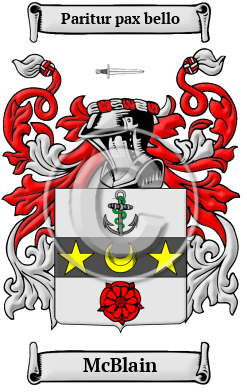
The motto was originally a war cry or slogan. Mottoes first began to be shown with arms in the 14th and 15th centuries, but were not in general use until the 17th century. Thus the oldest coats of arms generally do not include a motto. Mottoes seldom form part of the grant of arms: Under most heraldic authorities, a motto is an optional component of the coat of arms, and can be added to or changed at will; many families have chosen not to display a motto.
Motto: Paritur pax bello
Motto Translation: Peace is obtained by war.
- Black, George F., The Surnames of Scotland Their Origin, Meaning and History. New York: New York Public Library, 1946. Print. (ISBN 0-87104-172-3)
- Reaney, P.H and R.M. Wilson, A Dictionary of English Surnames. London: Routledge, 1991. Print. (ISBN 0-415-05737-X)
- Arthur, William , An Etymological Dictionary of Family and Christian Names. London: 1857. Print
- Generals of World War II. (Retrieved 2013, February 12) John McBlain. Retrieved from http://generals.dk/general/McBlain/John_Ferral/USA.html
- The Political Graveyard: Alphabetical Name Index. (Retrieved 2016, January 14) . Retrieved from http://politicalgraveyard.com/alpha/index.html
 |