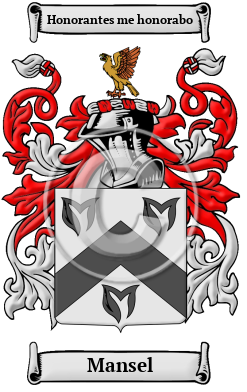
| ![Show Contents]() Mansel History, Family Crest & Coats of Arms Mansel History, Family Crest & Coats of Arms
Etymology of ManselWhat does the name Mansel mean? The history of the Mansel family name begins after the Norman Conquest of 1066. They lived in Glamorgan. Their name, however, is a reference to the family's place of residence prior to the Norman Conquest of England in 1066, Le Mans, Normandy. "This name is frequently found in the Norman Exchequer Rolls of the twelfth century, and certainly remained in Normandy for upwards of six hundred years." 1 Early Origins of the Mansel familyThe surname Mansel was first found in Glamorgan where they held a family seat as Lords of the Manor of Oxwick. Sir Phillip de Maunsell (Mansel) accompanied William, Duke of Normandy at Hastings in the Conquest of England in 1066 A.D. He was succeeded by Henry Maunsell, who was father of Sir John Maunsell (c.1190-1265,) Chief Justice of England about 1130 A.D. He received "from Philip Harley (called in the pedigree his grandfather) the manor of Oxmuth or Ormuch in Glamorgan, which long remained the dwelling place of his family. From him descended the celebrated ecclesiastic John Mancel, who in the time of Henry III. ranked among the first men in the land. He was reputed to be the richest clerk in the world, and as a proof of 'the enormities of the principles of plurality and nonresidence which prevailed in those days,' it is computed that he held seven hundred livings (jobs) at one and the same time !" 1 But, there is another version of this family's origins: "the curious poetical history of this family, preserved in 'Collectanea Topographica et Genealogica,' claims one 'Saher' there written 'Sier, the syer of us all,' as their ancestor: he is stated to have been the son of Ralph Maunsel, who was living in Buckinghamshire in the 14th of Henry II. (1167). " 2 "A priory for Black canons was founded [at Bilsington, Kent], before the year 1253, by John Mansell, provost of Beverley, who dedicated it to the Blessed Virgin." 3 The Hundredorum Rolls of 1273 had several entries for the family using various early spellings: Thomas le Mansell in Buckinghamshire; Sampson le Maunse in Bedfordshire; Frater Maunsel in Norfolk; Maunsel (without surname) in Huntingdonshire; and Thomas Maunsel in Cambridgeshire. Over one hundred years later, the Yorkshire Poll Tax Rolls of 1379 had two entries: Johannes Mauncell; and Alicia Maunsell. 4 The last entry is very significant in that entries for women were indeed rare at this time. Early History of the Mansel familyThis web page shows only a small excerpt of our Mansel research. Another 95 words (7 lines of text) covering the years 1195, 1264, 1487, 1542, 1559, 1579, 1623, 1640, 1645, 1665, 1677 and 1699 are included under the topic Early Mansel History in all our PDF Extended History products and printed products wherever possible. Mansel Spelling VariationsAnglo-Norman names are characterized by a multitude of spelling variations. When the Normans became the ruling people of England in the 11th century, they introduced a new language into a society where the main languages of Old and later Middle English had no definite spelling rules. These languages were more often spoken than written, so they blended freely with one another. Contributing to this mixing of tongues was the fact that medieval scribes spelled words according to sound, ensuring that a person's name would appear differently in nearly every document in which it was recorded. The name has been spelled Maunsell, Maunsel, Mansel, Mancel, Mauncell, Mauncel, Mannsell, Mannsel and many more. Early Notables of the Mansel family- Sir John Maunsell, or Mansel (circa 1195-1264), Provost of Beverley, English judge, and Secretary of State and Chancellor to King Henry III
- Francis Mansell (1579-1665), Principal of Jesus College, Oxford
- Sir Rice Mansel of Margam (1487-1559), who was appointed Sheriff of Glamorgan, Wales in 1542
- Bussy Mansell (1623-1699), a Welsh politician and officer, Commander-in-Chief of the Parliamentary forces in Glamorgan, under Lord Fairfax, on 17 November 1645 and High Sheriff of Glamorgan in 1645 an...
Migration of the Mansel family to IrelandSome of the Mansel family moved to Ireland, but this topic is not covered in this excerpt.
Another 43 words (3 lines of text) about their life in Ireland is included in all our PDF Extended History products and printed products wherever possible.
| Mansel migration to the United States | + |
For many English families, the political and religious disarray that plagued their homeland made the frontiers of the New World an attractive prospect. Thousands migrated, aboard cramped disease-ridden ships. They arrived sick, poor, and hungry, but were welcomed in many cases with far greater opportunity than at home in England. Many of these hardy settlers went on to make important contributions to the emerging nations in which they landed. Among early immigrants bearing the name Mansel or a variant listed above were:
Mansel Settlers in United States in the 17th Century- John Mansel, who settled in Virginia in 1653
- Jon Mansel, who landed in Virginia in 1653 6
| Mansel migration to Canada | + |
Mansel Settlers in Canada in the 19th Century- Thomas Mansel, who arrived in Nova Scotia in 1802
- James Mansel, aged 45, a farmer, who arrived in Saint John, New Brunswick in 1834 aboard the barque "New Brunswick" from Liverpool, England
| Mansel migration to Australia | + |
Emigration to Australia included the Second Fleet of convicts, tradespeople and early settlers. Early immigrants include: Second Fleet - Mr. Thomas Mansell, (Mansfield), British settler convicted in Surrey, England in 1790, sentenced to 7 years for stealing, transported aboard the ship "Matilda" leaving in 1790 arriving in New South Wales, Australia in 1791 5
| Contemporary Notables of the name Mansel (post 1700) | + |
- James Mansel, American politician, Prohibition Candidate for Presidential Elector for Pennsylvania, 1900, 1904, 1908 7
- Henry Longueville Mansel (1820-1871), English philosopher and clergyman
- Sir Thomas Mansel (b. 1727), elevated to the peerage as Baron Mansel of Margam in 1723
- Sir Phillip Mansel,
- Canon James Seymour Denis Mansel,
- Sir Mansel Aylward CB FLSW (1942-2024), Welsh public health physician and academic, Chief Medical Officer, Medical Director and Chief Scientist at the U.K. Government Department for Work and Pensions
The motto was originally a war cry or slogan. Mottoes first began to be shown with arms in the 14th and 15th centuries, but were not in general use until the 17th century. Thus the oldest coats of arms generally do not include a motto. Mottoes seldom form part of the grant of arms: Under most heraldic authorities, a motto is an optional component of the coat of arms, and can be added to or changed at will; many families have chosen not to display a motto.
Motto: Honorantes me honorabo
Motto Translation: I will honour those who honour me.
- Cleveland, Dutchess of The Battle Abbey Roll with some Account of the Norman Lineages. London: John Murray, Abermarle Street, 1889. Print. Volume 3 of 3
- Shirley, Evelyn Philip, The Noble and Gentle Men of England; The Arms and Descents. Westminster: John Bower Nichols and Sons, 1866, Print.
- Lewis, Samuel, A Topographical Dictionary of England. Institute of Historical Research, 1848, Print.
- Bardsley, C.W, A Dictionary of English and Welsh Surnames: With Special American Instances. Wiltshire: Heraldry Today, 1901. Print. (ISBN 0-900455-44-6)
- Convict Records of Australia. Retrieved 4th February 2021 from https://convictrecords.com.au/ships
- Filby, P. William, Meyer, Mary K., Passenger and immigration lists index : a guide to published arrival records of about 500,000 passengers who came to the United States and Canada in the seventeenth, eighteenth, and nineteenth centuries. 1982-1985 Cumulated Supplements in Four Volumes Detroit, Mich. : Gale Research Co., 1985, Print (ISBN 0-8103-1795-8)
- The Political Graveyard: Alphabetical Name Index. (Retrieved 2015, October 26) . Retrieved from http://politicalgraveyard.com/alpha/index.html
 |