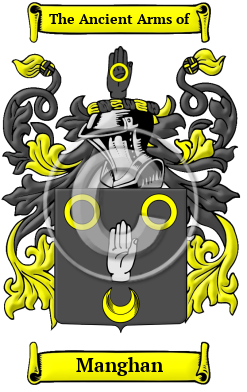
| ![Show Contents]() Manghan History, Family Crest & Coats of Arms Manghan History, Family Crest & Coats of Arms
- Origins Available:
Ireland
Etymology of ManghanWhat does the name Manghan mean? All Irish surnames have a unique and often romantic meaning. The name Manghan originally appeared in Gaelic as Ó Mongain, which is derived from the word mongach, which means hairy. 1 Early Origins of the Manghan familyThe surname Manghan was first found in Connacht (Irish: Connachta, (land of the) descendants of Conn), where they held a family seat and styled as one of the Irish Clanns who were descendants of King Niall of the Nine Hostages. They were descended through Eochy Moyvane, to Niall Mor, his son, the great Niall of the Nine Hostages. Descended was O'Mongain the great chief of the Mangans whose territories included branches in Mayo, Connacht, Cork and Limerick. Early History of the Manghan familyThis web page shows only a small excerpt of our Manghan research. Another 83 words (6 lines of text) covering the years 1772, 1803 and 1852 are included under the topic Early Manghan History in all our PDF Extended History products and printed products wherever possible. Manghan Spelling VariationsIn the Middle Ages many people were recorded under different spellings each time their name was written down. Research on the Manghan family name revealed numerous spelling variations, including Ó Mongain (Gaelic), Mangan, Mongan, Mongin, Mungan, Mungen, Mongun, O'Mongan, O'Mongin, O'Mungen, O'Mongun, O'Mongun, O'Mangan and many more. Early Notables of the Manghan familyMore information is included under the topic Early Manghan Notables in all our PDF Extended History products and printed products wherever possible. Migration of the Manghan familyIreland saw an enormous decrease in its population in the 19th century due to immigration and death. This pattern of immigration began slowly in the late 18th century and gradually grew throughout the early portion of the 19th century. However, a dramatic increase in the country's immigration numbers occurred when the Great Potato Famine struck in the 1840s. The early immigrants to North America were primarily destined to be farmers tending to their own plot of land, those that came later initially settled within pre-established urban centers. These urban immigrants provided the cheap labor that the fast developing United States and soon to be Canada required. Regardless of their new lifestyle in North America, the Irish immigrants to the United States and Canada made invaluable contributions to their newly adopted societies. An investigation of immigrant and passenger lists revealed many Manghans: John, Mary and Judy Mangan who arrived in New York State in 1853; Francis, Henry, James, John, Michael, Patrick, Thomas, and William Mangan, all arrived in Philadelphia, Pennsylvania between 1826 and 1868.
- MacLysaght, Edward, The Surnames of Ireland. Ireland: Irish Academic Press, sixth edition, 1985. Print. (ISBN 0-7165-2366-3)
 |