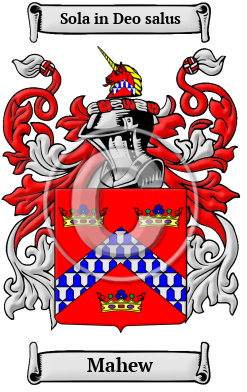
| ![Show Contents]() Mahew History, Family Crest & Coats of Arms Mahew History, Family Crest & Coats of Arms
- Origins Available:
England
Etymology of MahewWhat does the name Mahew mean? Mahew is a name that was brought to England by the ancestors of the Mahew family when they migrated to the region after the Norman Conquest in 1066. The Mahew family lived in Norfolk. Their name, however, derives from the family's place of residence prior to the Norman Conquest of England in 1066, Mayeux, Normandy. 1 Alternatively the name could have been "an Anglo-French form of Matthew." 2 3 4 Early Origins of the Mahew familyThe surname Mahew was first found in Berkshire where Geoffrey Maheu was listed c. 1240. A few years later, William Mahu was recorded in the Subsidy Rolls for Sussex in 1296 and William Mayhew was found in Colchester in 1351. Later again, John Mayho was recorded in Kent in 1428 and John Mayhow and William Mayo were both listed in the Subsidy Rolls for Suffolk in 1524. 5 Early History of the Mahew familyThis web page shows only a small excerpt of our Mahew research. Another 92 words (7 lines of text) covering the years 1569, 1593, 1600, 1621, 1625, 1631, 1642, 1644, 1673, 1681, 1682, 1696, 1697, 1700, 1710 and 1758 are included under the topic Early Mahew History in all our PDF Extended History products and printed products wherever possible. Mahew Spelling VariationsSpelling variations in names were a common occurrence in the eras before English spelling was standardized a few hundred years ago. In the Middle Ages, even the literate regularly changed the spellings of their names as the English language incorporated elements of French, Latin, and other European languages. Many variations of the name Mahew have been found, including Mayhew, Mahewe, Mahugh, Mayhugh, Mayhuys, Mayhue and others. Early Notables of the Mahew familyEdward Mayhew (1569-1625), an English Benedictine. His family was Mayhew or Mayow from Winton, near Salisbury, Wiltshire. Governor Thomas Mayhew, the Elder (1593-1682) established the first European settlement in Martha's Vineyard, Nantucket and adjacent islands in 1642. He is one of the editors of the Bay Psalm Book, the first book published in the Thirteen Colonies. He was born in Tisbury, Wiltshire in England and married Anna (also called Hanna and Abigail) Parkhurst, born about 1600, in Hampshire, England. In 1621 they had a son, Thomas, the Younger, baptised in Hanna's home town of Southampton. Two years later they had another...
Another 188 words (13 lines of text) are included under the topic Early Mahew Notables in all our PDF Extended History products and printed products wherever possible.
| Mahew migration to the United States | + |
For many English families, the social climate in England was oppressive and lacked opportunity for change. For such families, the shores of Ireland, Australia, and the New World beckoned. They left their homeland at great expense in ships that were overcrowded and full of disease. Many arrived after the long voyage sick, starving, and without a penny. But even those were greeted with greater opportunity than they could have experienced back home. Numerous English settlers who arrived in the United States and Canada at this time went on to make important contributions to the developing cultures of those countries. Many of those families went on to make significant contributions to the rapidly developing colonies in which they settled. Early North American records indicate many people bearing the name Mahew were among those contributors:
Mahew Settlers in United States in the 17th Century- John Mahew, who arrived in Virginia in 1663 6
| Mahew migration to New Zealand | + |
Emigration to New Zealand followed in the footsteps of the European explorers, such as Captain Cook (1769-70): first came sealers, whalers, missionaries, and traders. By 1838, the British New Zealand Company had begun buying land from the Maori tribes, and selling it to settlers, and, after the Treaty of Waitangi in 1840, many British families set out on the arduous six month journey from Britain to Aotearoa to start a new life. Early immigrants include: Mahew Settlers in New Zealand in the 19th Century- Mr. George F. Mahew, British settler travelling from London aboard the ship "Gypsy" arriving in Auckland, New Zealand on 18th October 1856 7
The motto was originally a war cry or slogan. Mottoes first began to be shown with arms in the 14th and 15th centuries, but were not in general use until the 17th century. Thus the oldest coats of arms generally do not include a motto. Mottoes seldom form part of the grant of arms: Under most heraldic authorities, a motto is an optional component of the coat of arms, and can be added to or changed at will; many families have chosen not to display a motto.
Motto: Sola in Deo salus
Motto Translation: Safety in God alone.
- The Norman People and Their Existing Descendants in the British Dominions and the United States Of America. Baltimore: Genealogical Publishing, 1975. Print. (ISBN 0-8063-0636-X)
- Harrison, Henry, Surnames of the United Kingdom: A Concise Etymological Dictionary Baltimore: Geneological Publishing Company, 2013. Print
- Barber, Henry, British Family Names London: Elliot Stock, 62 Paternoster Row, 1894. Print.
- Lower, Mark Anthony, Patronymica Britannica, A Dictionary of Family Names of the United Kingdom. London: John Russel Smith, 1860. Print.
- Reaney, P.H and R.M. Wilson, A Dictionary of English Surnames. London: Routledge, 1991. Print. (ISBN 0-415-05737-X)
- Filby, P. William, Meyer, Mary K., Passenger and immigration lists index : a guide to published arrival records of about 500,000 passengers who came to the United States and Canada in the seventeenth, eighteenth, and nineteenth centuries. 1982-1985 Cumulated Supplements in Four Volumes Detroit, Mich. : Gale Research Co., 1985, Print (ISBN 0-8103-1795-8)
- New Zealand Yesteryears Passenger Lists 1800 to 1900 (Retrieved 17th October 2018). Retrieved from http://www.yesteryears.co.nz/shipping/passlist.html
 |