| ![Show Contents]() MacKen History, Family Crest & Coats of Arms MacKen History, Family Crest & Coats of Arms
Etymology of MacKenWhat does the name MacKen mean? On the Scottish west coast, the MacKen family was born among the ancient Dalriadan clans. Their name comes from the given name Ian or John. John is the most common personal name in the Highlands. The Gaelic form of the name is Mac Iain. Early Origins of the MacKen familyThe surname MacKen was first found in Argyllshire (Gaelic erra Ghaidheal), the region of western Scotland corresponding roughly with the ancient Kingdom of Dál Riata, in the Strathclyde region of Scotland, now part of the Council Area of Argyll and Bute, where they held a family seat from early times and their first records appeared on the early census rolls taken by the early Kings of Britain to determine the rate of taxation of their subjects. Early History of the MacKen familyThis web page shows only a small excerpt of our MacKen research. Another 166 words (12 lines of text) covering the years 1292, 1340, 1618, 1667, 1717, 1777, 1808, 1875 and 1890 are included under the topic Early MacKen History in all our PDF Extended History products and printed products wherever possible. MacKen Spelling VariationsIn the Middle Ages, the translation between Gaelic and English was not a highly developed process. Spelling was not yet standardized, and so, an enormous number of spelling variations appear in records of early Scottish names. MacKen has appeared as MacIan, MacAne, MacKane, MacKean, MacKain and others. Early Notables of the MacKen familyArchibald McKain (1717-1777), Scottish Shoemaker and Burgess of Elgin, Morayshire, who became the 15th Chief of MacIain of Ardnamurchan. Also of note was Thomas M'kean of Delaware, one of the signers of the American Declaration of Independence.
John Canne (d. 1667?), was an English divine and printer and "may...
Another 48 words (3 lines of text) are included under the topic Early MacKen Notables in all our PDF Extended History products and printed products wherever possible. Migration of the MacKen family to IrelandSome of the MacKen family moved to Ireland, but this topic is not covered in this excerpt.
Another 80 words (6 lines of text) about their life in Ireland is included in all our PDF Extended History products and printed products wherever possible.
| MacKen migration to the United States | + |
These settlers arrived in North America at a time when the east was burgeoning with prosperous colonies and the expanses of the west were just being opened up. The American War of Independence was also imminent. Some Scots stayed to fight for a new country, while others who remained loyal went north as United Empire Loyalists. The ancestors of all of them went on to rediscover their heritage in the 20th century through highland games and other patriotic Scottish events. The MacKen were among these contributors, for they have been located in early North American records:
MacKen Settlers in United States in the 17th Century- William Macken, who arrived in Boston, Massachusetts in 1651 1
- William Macken, who arrived in America in 1652 1
MacKen Settlers in United States in the 19th Century- Cath Macken, aged 18, who landed in New York in 1854 1
- Hugh, Michael, Patrick, Thomas, and William Macken also, who arrived in Philadelphia between 1840 and 1860
| MacKen migration to Australia | + |
MacKen Settlers in Australia in the 19th Century- Mr. Thomas Macken, (b. 1817), aged 21, Irish labourer who was convicted in Monaghan, Ireland for 7 years for larceny, transported aboard the "Clyde" on 11th May 1838, arriving in New South Wales, Australia 2
| Contemporary Notables of the name MacKen (post 1700) | + |
- Francis Macken, American politician, Member of New Jersey State House of Assembly from Essex County, 1868-69 3
- Daniel E. Macken, American Republican politician, Justice of New York Supreme Court 7th District; Elected 1960 4
- Anthony "Tony" Macken (b. 1950), Irish former professional footballer
- Fidelma O'Kelly Macken (b. 1942), Irish retired judge of the Supreme Court of Ireland (2005-2012), Judge of the European Court of Justice (2004-2005)
- Tara Macken, Kuwait-born, stunt woman and actress, known for her work on The Mentalist, Star Trek Into Darkness, Iron Man 3 and many more
- Peter Neville Macken (b. 1938), Australian modern pentathlete and fencer, five-time Olympian
- Walter Macken (1915-1967), Irish writer of short stories, novels and plays
- Eoin Christopher Macken (b. 1983), Irish actor, film maker and model
- Eddie Macken (b. 1949), Irish three-time silver equestrian show jumper, former Olympian
- ... (Another 2 notables are available in all our PDF Extended History products and printed products wherever possible.)
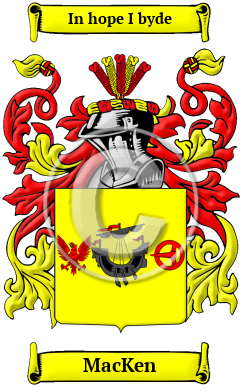
The motto was originally a war cry or slogan. Mottoes first began to be shown with arms in the 14th and 15th centuries, but were not in general use until the 17th century. Thus the oldest coats of arms generally do not include a motto. Mottoes seldom form part of the grant of arms: Under most heraldic authorities, a motto is an optional component of the coat of arms, and can be added to or changed at will; many families have chosen not to display a motto.
Motto: In hope I byde
- Filby, P. William, Meyer, Mary K., Passenger and immigration lists index : a guide to published arrival records of about 500,000 passengers who came to the United States and Canada in the seventeenth, eighteenth, and nineteenth centuries. 1982-1985 Cumulated Supplements in Four Volumes Detroit, Mich. : Gale Research Co., 1985, Print (ISBN 0-8103-1795-8)
- Convict Records Voyages to Australia (Retrieved 24th February 2021). Retrieved from https://convictrecords.com.au/ships/clyde
- The Political Graveyard: Alphabetical Name Index. (Retrieved 2016, January 7) . Retrieved from http://politicalgraveyard.com/alpha/index.html
 |