| ![Show Contents]() MacEnzie History, Family Crest & Coats of Arms MacEnzie History, Family Crest & Coats of Arms
- Origins Available:
Scotland
Ireland
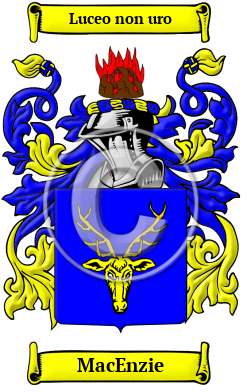
Etymology of MacEnzieWhat does the name MacEnzie mean? The MacEnzie family history stretches back to the clans of the Dalriadan kingdom on the sea-swept Hebrides islands and mountainous western coast of Scotland. The name MacEnzie is derived from the personal name Coinneach. The Gaelic form of the name is Mac Coinnich or Mac Choinnich, both of which mean son of Coinneach. However, In Adamnan, the Gaelic form of the name is Cainnechus, which is derived from the word cann, meaning fair or bright; thus, the surname is of the 'nickname' variety in this case. MacEnzie Coat of Arms CreationThe Mackenzies have a deer's head for their crest, and the Gaelic motto, " Cuidich an Righ " (Help the King), alleged to have been given under the following circumstances: The founder of the family, Colin Fitzgerald, who was reputed to be an Irish adventurer, was, in 1265, with his sovereign, Alexander III., hunting in the forest of Mar, when a stag, pursued by the hounds, made straight for the King. The brave Colin interposed his own person between His Majesty and the infuriated animal, shot the stag in the forehead, and in gratitude he was granted the right to use as his armorial bearings a stag's head bleeding where the arrow pierced it, with two greyhounds as supporters. The incident of the hunt was painted by B. West for the last of the Seaforths. The artist received £800 for the noble picture, which is still preserved in Brahan Castle. According to Nisbet their crest was a sun in its splendour, and the motto, " Luceo non uro " (I shine but I do not burn), which motto is now on the beautiful old furniture in Brahan Castle; but neither the above crest nor motto is shown in Burke's Peerage. 1 Early Origins of the MacEnzie familyThe surname MacEnzie was first found in Ross-shire (Gaelic: Siorrachd Rois) a former county, now part of the Council Areas of Highland and Western Isles in Northern Scotland, which emerged from the Gaelic lordship of the Earl of Ross, where they held a family seat from early times and their first records appeared on the early census rolls taken by the early Kings of Britain to determine the rate of taxation of their subjects. Early History of the MacEnzie familyThis web page shows only a small excerpt of our MacEnzie research. Another 192 words (14 lines of text) covering the years 1278, 1561, 1568, 1569, 1594, 1611, 1630, 1635, 1636, 1651, 1662, 1677, 1678, 1688, 1691, 1714, 1715, 1771 and 1890 are included under the topic Early MacEnzie History in all our PDF Extended History products and printed products wherever possible. MacEnzie Spelling VariationsSpelling in the medieval era was a highly imprecise process. Translation, particularly from Gaelic to English, was little better. For these reasons, early Scottish names are rife with spelling variations. In various documents MacEnzie has been spelled MacKenzie, McKenzie, Kennethson, Kenneth, Kennieson, MacCoinnich (Gaelic), MacWhinnie, MacWhinny, MacWhinney and many more. Early Notables of the MacEnzie familyJohn Mackenzie (died c. 1561), or "John of Killin", traditionally reckoned 9th of Kintail, a Highland chief; Kenneth Mackenzie (died 1568), 10th of Kintail and nicknamed Coinneach na Cuirc (or "Kenneth of the Whittle"), a Highland chief; Colin Mackenzie of Kintail (died 1594), nicknamed "Cam" ("crooked", because one-eyed), a Highland chief; Kenneth Mackenzie, the first Lord Mackenzie of Kintail (c.1569-1611), a Highland Clan chief; George Mackenzie, 2nd Earl of Seaforth (died 1651)...
Another 71 words (5 lines of text) are included under the topic Early MacEnzie Notables in all our PDF Extended History products and printed products wherever possible. Migration of the MacEnzie family to IrelandSome of the MacEnzie family moved to Ireland, but this topic is not covered in this excerpt.
Another 57 words (4 lines of text) about their life in Ireland is included in all our PDF Extended History products and printed products wherever possible. Migration of the MacEnzie familySettlers from Scotland put down roots in communities all along the east coast of North America. Some moved north from the American colonies to Canada as United Empire Loyalists during the American War of Independence. As Clan societies and highland games started in North America in the 20th century many Scots rediscovered parts of their heritage. Early North American records indicate many people bearing the name MacEnzie were among those contributors: Alexander McKenzie, his wife Isobel and their four children, who settled in Philadelphia in 1775; John and Mary McKenzie, who settled with two children in New York in 1738.
| MacEnzie Motto and War Cry | + |
The motto was originally a war cry or slogan. Mottoes first began to be shown with arms in the 14th and 15th centuries, but were not in general use until the 17th century. Thus the oldest coats of arms generally do not include a motto. Mottoes seldom form part of the grant of arms: Under most heraldic authorities, a motto is an optional component of the coat of arms, and can be added to or changed at will; many families have chosen not to display a motto.
Motto: Luceo non uro
Motto Translation: I shine not burn.
War Cry: "Tullaich Ard."
- Polson, Alexander, The Romance of Scottish Crests and Mottoes. Inverness: Walter Alexander, Inglis Street 1929. Print
 |