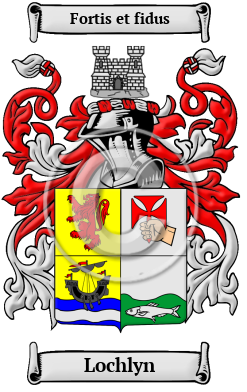
| ![Show Contents]() Lochlyn History, Family Crest & Coats of Arms Lochlyn History, Family Crest & Coats of Arms
Etymology of LochlynWhat does the name Lochlyn mean? Lochlyn is a very old Scottish name that may even date back to the Dalriadan tribe of Scotland's western coast and Hebrides islands. It comes from the personal name Lachlann. The Gaelic form of the name is Mac Lachlainn, denoting the son of Lachlann. Although most feel Lachlan Mor, a great Chief who lived by Loch Fyne in the thirteenth century, is the Clan founder, the legend of descent from the ancient Gaelic King, Niall of the Nine Hostages, who reigned in 400 AD, offers some clues as to the clan's early origins. Lochlann, in old Gaelic means literally, 'Norway,' and was the favorite Christian name of the royal house of O'Neill in Northern Ireland, a house descended from Niall of the Nine hostages, and said to be the family with the oldest history in Europe. A branch of the O'Neill's took the surname MacLochlain and soon became rival Kings to the O'Neills. King Brian O'Neill slew the last King Domnall MacLochlainn. His son Anrothan, who was ancestor of the MacLachlans in Scotland, married the daughter of the King of Scots, thereby gaining the inheritance of Cowall and Knapdale in Scotland. Anrothan MacLachlan was progenitor of the MacLachlans of Strathlachlan, the Lamonts, the Lyons, the MacSorleys, the MacEwans, and the MacMillans. It was in the mid-twelfth century that each of these branches separated into distinct entities. Early Origins of the Lochlyn familyThe surname Lochlyn was first found in Argyllshire (Gaelic erra Ghaidheal), the region of western Scotland corresponding roughly with the ancient Kingdom of Dál Riata, in the Strathclyde region of Scotland, now part of the Council Area of Argyll and Bute, where this Clan first settled in Scotland in 1100 when Lachlan was heir of Fergus, Lord of Galloway. In 1238, a charter recorded Lachlan Mor's father increasing the endowment to Paisley Abbey. When, in 1292, King John Baliol erected Argyll into a sheriffdom, Gillescop MacLachlan was one of the twelve principal barons whose land it encompassed. In 1296, Ewen MacLachlan was forced to swear loyalty to the English King Edward I, but this loyalty was formally changed back to Scotland in 1305, when Gillescop MacLachlan, like his neighbors the Campbells, swore allegiance to Robert the Bruce. Gillescop was a member of the Barons of Bruce's first parliament at St. Andrews, in 1308. 1 King John of England (reigned: 1199-1216) was also known as John Lackland from the Norman French, "Johan sanz Terre" or "John without land." Early History of the Lochlyn familyThis web page shows only a small excerpt of our Lochlyn research. Another 104 words (7 lines of text) covering the years 1292, 1600 and 1890 are included under the topic Early Lochlyn History in all our PDF Extended History products and printed products wherever possible. Lochlyn Spelling VariationsSpelling variations are a very common occurrence in records of early Scottish names. They result from the repeated and inaccurate translations that many names went through in the course of various English occupations of Scotland. Lochlyn has been spelled MacLachlan, Lachlan, MacLachlane, McGlothan, McGlothin, MacLauchlan, MacLauchlane, MacLauchlin, MacLaughlin, Lauchlan and many more. Early Notables of the Lochlyn familyMore information is included under the topic Early Lochlyn Notables in all our PDF Extended History products and printed products wherever possible. Migration of the Lochlyn family to IrelandSome of the Lochlyn family moved to Ireland, but this topic is not covered in this excerpt.
Another 66 words (5 lines of text) about their life in Ireland is included in all our PDF Extended History products and printed products wherever possible. Migration of the Lochlyn familyNumerous Scottish settlers settled along the east coast of the colonies that would become the United States and Canada. Others traveled to the open country of the west. At the time of the American War of Independence, some remained in the United States, while those who remained loyal to the crown went north to Canada as United Empire Loyalists. The highland games and Clan societies that sprang up across North America in the 20th century have helped many Scots to recover parts of their lost traditions. Research into passenger and immigration lists has revealed some of the very first Lochlyns to arrive in North America: William Lachlan, who arrived in Pennsylvania in 1847; Thomas Laughlin settled in Virginia in 1654; Adam Laughlin settled in New England in 1805; John Laughlin settled in Pennsylvania in 1823.
The motto was originally a war cry or slogan. Mottoes first began to be shown with arms in the 14th and 15th centuries, but were not in general use until the 17th century. Thus the oldest coats of arms generally do not include a motto. Mottoes seldom form part of the grant of arms: Under most heraldic authorities, a motto is an optional component of the coat of arms, and can be added to or changed at will; many families have chosen not to display a motto.
Motto: Fortis et fidus
Motto Translation: Brave and trusty.
- Black, George F., The Surnames of Scotland Their Origin, Meaning and History. New York: New York Public Library, 1946. Print. (ISBN 0-87104-172-3)
 |