| ![Show Contents]() Lices History, Family Crest & Coats of Arms Lices History, Family Crest & Coats of Arms
Etymology of LicesWhat does the name Lices mean? As a native Irish surname, Lices is derived from the Gaelic name Mac Laoidhigh, which comes from the word "laoidh," which means "a poem;" or from Mac Giolla Iosa, which means "son of the devotee of Jesus." However, Lee is also a common indigenous name in England, many families of which have been established in Ireland since at least the 17th century. 1 Early Origins of the Lices familyThe surname Lices was first found in Connacht (Irish: Connachta, (land of the) descendants of Conn), where they were prominent in the west being anciently associated as hereditary physicians to the O'Flahertys. Families with the McLees or McAlees spellings were traditionally doctors or physicians. By the 16th century different branches had developed in Galway, in Leix, and in Munster at Cork and Limerick. The name in Gaelic was O'Laidhigh. Early History of the Lices familyThis web page shows only a small excerpt of our Lices research. Another 121 words (9 lines of text) covering the years 1253, 1600, 1650 and 1734 are included under the topic Early Lices History in all our PDF Extended History products and printed products wherever possible. Lices Spelling VariationsThe recording of names in Ireland during the Middle Ages was an inconsistent endeavor at best. Since the general population did not know how to read or write, they could only specify how their names should be recorded orally. Research into the name Lices revealed spelling variations, including McAlea, McAlee, MacAlee, MacAlea, MacLee, McLee, MacLees, McLees, MacLeas, McLeas, O'Lees, O'Leas, Lee and many more. Early Notables of the Lices familyMore information is included under the topic Early Lices Notables in all our PDF Extended History products and printed products wherever possible. Migration of the Lices familyDeath and immigration greatly reduced Ireland's population in the 19th century. For the native Irish people poverty, hunger, and racial prejudice was common. Therefore, thousands left their homeland to seek opportunity in North America. Those who survived the journey and the quarantine camps to which they arrived, were instrumental towards building the strong developing nations of the United States and the future Canada. By far, the largest influx of Irish settlers occurred with Great Potato Famine during the late 1840s. These were employed as construction or factory workers. An examination of passenger and immigration lists has shown early immigrants bearing the name Lices: Hugh O'Lee, who settled in Maryland in 1658; William McLea, who arrived in New York in 1775; James McLea, who settled in Savannah Georgia in 1821; Biddy Lees, who arrived in St. John, N.B. in 1834 aboard the Brig ".
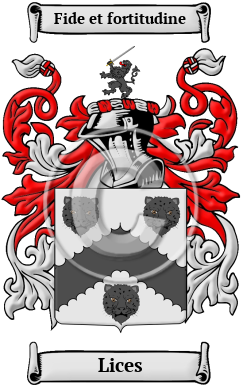
The motto was originally a war cry or slogan. Mottoes first began to be shown with arms in the 14th and 15th centuries, but were not in general use until the 17th century. Thus the oldest coats of arms generally do not include a motto. Mottoes seldom form part of the grant of arms: Under most heraldic authorities, a motto is an optional component of the coat of arms, and can be added to or changed at will; many families have chosen not to display a motto.
Motto: Fide et fortitudine
Motto Translation: By fidelity and fortitude.
- MacLysaght, Edward, Irish Families Their Names, Arms and Origins 4th Edition. Dublin: Irish Academic, 1982. Print. (ISBN 0-7165-2364-7)
 |