| ![Show Contents]() Learey History, Family Crest & Coats of Arms Learey History, Family Crest & Coats of Arms
Etymology of LeareyWhat does the name Learey mean? While many Irish names are familiar, their past incarnations are often shrouded in mystery, reflecting the ancient Gaelic heritage of their bearers. The original Gaelic form of the name Learey is Ó Laoghaire, which was originally derived from Laoghaire, one of the most well-known personal names in ancient Ireland. 1 Early Origins of the Learey familyThe surname Learey was first found in County Cork (Irish: Corcaigh) the ancient Kingdom of Deis Muin (Desmond), located on the southwest coast of Ireland in the province of Munster, where they held a family seat from ancient times. The sept claim descent through the Heber line of Irish kings and in turn, through the O'Connell pedigree. (O'Hart) The family was ancient landholders as the Civil Survey of 1654 lists over thirty-four of the hundred and three were O'Leary. 2 Early History of the Learey familyThis web page shows only a small excerpt of our Learey research. Another 86 words (6 lines of text) covering the years 1172, 1729, 1756, 1795, 1802, 1818, 1831, 1842, 1845, 1863 and 1889 are included under the topic Early Learey History in all our PDF Extended History products and printed products wherever possible. Learey Spelling VariationsThe scribes who created documents long before either the Gaelic or English language resembled their standardized versions of today recorded words as they sounded. Consequently, in the Middle Ages the names of many people were recorded under different spellings each time they were written down. Research on the Learey family name revealed numerous spelling variations, including Leary, O'Leary, O'Leery and others. Early Notables of the Learey familyArthur O'Leary (1729-1802), Irish priest and politician, was born in 1729 at Acres, a townland in the parish of Fanlobbus, near Dumnanway, Co. Cork, his parents being of the peasant class. Having acquired some knowledge of classical literature, he went to a monastery; of Capuchin friars at St. Malo in Brittany. There he entered the Capuchin order, and was ordained priest. In the course of the war between England and France which commenced in 1756 prisoners of war made by the French were confined at St. Malo; many of them were Irishmen and Catholics, and O'Leary was appointed chaplain to the...
Another 182 words (13 lines of text) are included under the topic Early Learey Notables in all our PDF Extended History products and printed products wherever possible.
| Learey migration to the United States | + |
Many Irish families boarded ships bound for North America in the middle of 19th century to escape the conditions of poverty and racial discrimination . Although these immigrants often arrived in a destitute state, they went on to make important contributions to the emerging nations of the United States and Canada. An inquiry into many immigration and passenger lists has revealed many early immigrants to North America bearing the Learey family name:
Learey Settlers in United States in the 19th Century- Nancy Learey, aged 26, who arrived in New York in 1854 3
The motto was originally a war cry or slogan. Mottoes first began to be shown with arms in the 14th and 15th centuries, but were not in general use until the 17th century. Thus the oldest coats of arms generally do not include a motto. Mottoes seldom form part of the grant of arms: Under most heraldic authorities, a motto is an optional component of the coat of arms, and can be added to or changed at will; many families have chosen not to display a motto.
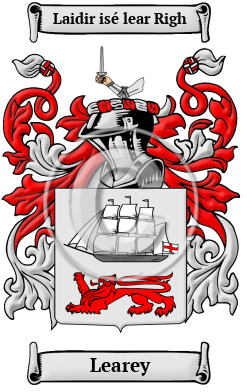
Motto: Laidir isé lear Righ
Motto Translation: Strong is the King of the sea.
- MacLysaght, Edward, Supplement to Irish Families. Baltimore: Genealogical Book Company, 1964. Print.
- MacLysaght, Edward, Irish Families Their Names, Arms and Origins 4th Edition. Dublin: Irish Academic, 1982. Print. (ISBN 0-7165-2364-7)
- Filby, P. William, Meyer, Mary K., Passenger and immigration lists index : a guide to published arrival records of about 500,000 passengers who came to the United States and Canada in the seventeenth, eighteenth, and nineteenth centuries. 1982-1985 Cumulated Supplements in Four Volumes Detroit, Mich. : Gale Research Co., 1985, Print (ISBN 0-8103-1795-8)
 |