| ![Show Contents]() Laveine History, Family Crest & Coats of Arms Laveine History, Family Crest & Coats of Arms
- Origins Available:
France
Etymology of LaveineWhat does the name Laveine mean? The history of the Laveine family goes back to the Medieval landscape of northwestern France, to the regions known as Brittany and Normandy. The name Lavigne is derived from the Old French word "vigne," meaning "vine," and as such it is likely that the first bearers of this name owned or worked on a vineyard. 1 Early Origins of the Laveine familyThe surname Laveine was first found in Brittany where they held a family seat in the seigneury of Haute Morays. They later branched to Houle in that same province. They were closely allied to this latter House of Houlle de Kermassonet. Branching to the region of Tournai they intermarried with the family of Hennebert. Branches were later found in Maine, Le Mans, Bourbonnais, Guyenne, and Artois. In the south of France they held a family seat in the region of Languedoc at Puylaroque. Joseph Lavigne, son of Pierre and Jeanne (née Gazaille), settled in Contrecoeur, Quebec and married Marie-Anne Gareau on 12th November 1727. 2 Early History of the Laveine familyThis web page shows only a small excerpt of our Laveine research. More information is included under the topic Early Laveine History in all our PDF Extended History products and printed products wherever possible. Laveine Spelling VariationsThere were a great number of spelling variations in French surnames. One reason for this was the wide variety of cultural influences present in France during the early development of the French language. The many spelling variations of the name include Lavigne, Levine, Levin, Levigne, Levigny, Laveine, Lavignes, Lavene, Des Vignes, deVigne, Devignes, Devigne, De lavigne and many more. Early Notables of the Laveine familyMore information is included under the topic Early Laveine Notables in all our PDF Extended History products and printed products wherever possible.
| Laveine migration to the United States | + |
France was active as a cultural leader in the early 16th century. One particular area in which they lead was the exploration of the New World. The explorers, like Jacques Cartier in 1534, led the way to North America. Champlain, in 1608, made the first of twenty voyages to France to attract settlers and brought the first migrant in 1617. By 1675, there were 7000 French in Quebec, and the French Acadian presence in the Maritimes had reached 500. The French founded Lower Canada, thus becoming one of the two great founding nations of Canada. The family name Laveine has made many distinguished contributions in France and New France to the world of science, culture, religion, and education. Amongst the settlers in North America with this distinguished name Laveine were
Laveine Settlers in United States in the 18th Century- Nicolas Laveine, who landed in Louisiana in 1719 3
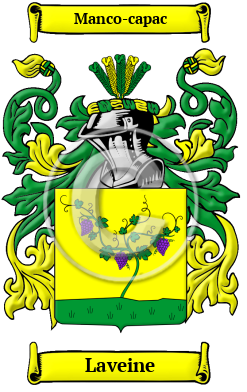
The motto was originally a war cry or slogan. Mottoes first began to be shown with arms in the 14th and 15th centuries, but were not in general use until the 17th century. Thus the oldest coats of arms generally do not include a motto. Mottoes seldom form part of the grant of arms: Under most heraldic authorities, a motto is an optional component of the coat of arms, and can be added to or changed at will; many families have chosen not to display a motto.
Motto: Manco-capac
- Dionne, N.-E., Origine Des Familles Canadiennes-Français. Baltimore: Genealogical Publishing Company, 1969. Print.
- Olivier, Reginald L. Your Ancient Canadian Family Ties. Logan: The Everton Publishers, Inc., P.O. Box 368, 1972. Print
- Filby, P. William, Meyer, Mary K., Passenger and immigration lists index : a guide to published arrival records of about 500,000 passengers who came to the United States and Canada in the seventeenth, eighteenth, and nineteenth centuries. 1982-1985 Cumulated Supplements in Four Volumes Detroit, Mich. : Gale Research Co., 1985, Print (ISBN 0-8103-1795-8)
 |