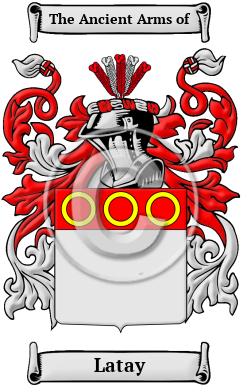
| ![Show Contents]() Latay History, Family Crest & Coats of Arms Latay History, Family Crest & Coats of Arms
Etymology of LatayWhat does the name Latay mean? Latay is an Anglo-Saxon name. The name was originally given to a person who worked as a servant of a noble lady as in ' the lady's man.' 1 2 However, another source has a different occupational background "a man who has the charge of a horse-load or of a pack-horse." 3 The name is "a Northern, particularly Yorkshire, surname." 1 Early Origins of the Latay familyThe surname Latay was first found in Lincolnshire where Rannulf (le) Lauediman was recorded in the Feet of Fines for 1202. It is thought the same person was listed in Northumberland in the Curia Regis Rolls for 1214. Geoffrey le Leuediman was recorded in Yorkshire in the 13th century and Roger Ladyman was recorded in Hertfordshire in 1296. 4 The Yorkshire Poll Tax Rolls of 1379 has some interesting spelling variations in use at that time: Ricardus Ledyman; Johanna ye Laydimayden; and Johannes Serve-ledy. 2 Early History of the Latay familyThis web page shows only a small excerpt of our Latay research. Another 207 words (15 lines of text) covering the years 1214, 1296, 1379, 1397, 1399, 1581, 1625, 1642, 1647, 1648, 1649, 1658, 1677, 1683, 1684, 1700, 1731 and 1787 are included under the topic Early Latay History in all our PDF Extended History products and printed products wherever possible. Latay Spelling VariationsOne relatively recent invention that did much to standardize English spelling was the printing press. However, before its invention even the most literate people recorded their names according to sound rather than spelling. The spelling variations under which the name Latay has appeared include Ladyman, Ledyman, Ladymen, Laudyman, Lauediman, Laydimayden and many more. Early Notables of the Latay familySamuel Ladyman, (1625-1684), English divine, Archdeacon of Limerick, Ireland. He was the son of John Ladyman of Dinton, Buckinghamshire. He entered Corpus Christi College, Oxford, as a servitor 3 March 1642, graduated B.A. on 13 July 1647, was made fellow by the parliamentary visitors in 1648, and graduated M.A. on 21 June 1649. In May 1658 he was one of some thirty ministers summoned to Dublin by Henry Cromwell, for consultation on church...
Another 72 words (5 lines of text) are included under the topic Early Latay Notables in all our PDF Extended History products and printed products wherever possible. Migration of the Latay family to IrelandSome of the Latay family moved to Ireland, but this topic is not covered in this excerpt.
Another 52 words (4 lines of text) about their life in Ireland is included in all our PDF Extended History products and printed products wherever possible. Migration of the Latay familyAt this time, the shores of the New World beckoned many English families that felt that the social climate in England was oppressive and lacked opportunity for change. Thousands left England at great expense in ships that were overcrowded and full of disease. A great portion of these settlers never survived the journey and even a greater number arrived sick, starving, and without a penny. The survivors, however, were often greeted with greater opportunity than they could have experienced back home. These English settlers made significant contributions to those colonies that would eventually become the United States and Canada. An examination of early immigration records and passenger ship lists revealed that people bearing the name Latay arrived in North America very early: Abigall Ladyman, who sailed to Virginia in 1695; and John Ladyman to Nova Scotia in 1749.
- Harrison, Henry, Surnames of the United Kingdom: A Concise Etymological Dictionary Baltimore: Geneological Publishing Company, 2013. Print
- Bardsley, C.W, A Dictionary of English and Welsh Surnames: With Special American Instances. Wiltshire: Heraldry Today, 1901. Print. (ISBN 0-900455-44-6)
- Charnock, Richard, Stephen, Ludus Patronymicus of The Etymology of Curious Surnames. London: Trubner & Co., 60 Paternoster Row, 1868. Print.
- Reaney, P.H and R.M. Wilson, A Dictionary of English Surnames. London: Routledge, 1991. Print. (ISBN 0-415-05737-X)
 |