| ![Show Contents]() Kinnikin History, Family Crest & Coats of Arms Kinnikin History, Family Crest & Coats of Arms
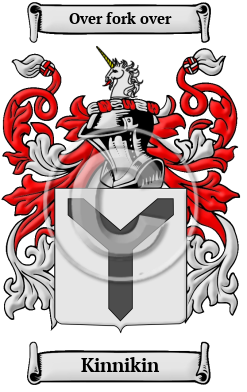
Etymology of KinnikinWhat does the name Kinnikin mean? The rugged west coast of Scotland in the kingdom of Dalriada is the setting from which came the Kinnikin name. The name derives from someone having lived at Cunningham in Ayrshire. However, numerous branches of the Cunningham family spread all over Scotland. Two of the most prominent branches of the Cunningham Clan, the Cunninghams of Corsehill and the Cunninghams of Caprington, trace their ancestry back to the medieval era. Kinnikin Coat of Arms CreationThe Cuninghames have as their crest a unicorn, and the motto is, " Over fork over." The unicorn is so named from its having only one horn, which grows out of its forehead. It represents strength, a haughty mind, and one who would rather die than be brought into subjection. The horn was said to possess a powerful antidote against poison, and that other animals were glad to drink of water stirred by the horn. As to the motto, the story is that Malcolm, the first of the family, assisted Malcolm (afterwards King Malcolm Canmore) to escape when pursued by Macbeth, by forking straw or hay over him. The King afterwards rewarded him by the gift of the Thanedom of Cuninghame, and the figure on the shield like the letter Y represents the shake-fork. The other story is that the motto is derived from the fact that an ancestor had charge of the King's horses, and the shakefork was the instrument by which hay was forked to them. 1 Early Origins of the Kinnikin familyThe surname Kinnikin was first found in Ayrshire (Gaelic: Siorrachd Inbhir Àir), formerly a county in the southwestern Strathclyde region of Scotland, that today makes up the Council Areas of South, East, and North Ayrshire. About the year 1050, it is said that Warnebald Cunningham saved King Malcolm Canmore by hiding him in the barn and covering him with hay concealing him from his pursuer the Pretender King, MacBeth. The grateful King Malcolm later bestowed on Warnebald the lands of Cunningham and the motto "Over Fork Over." 2 Early History of the Kinnikin familyThis web page shows only a small excerpt of our Kinnikin research. Another 119 words (8 lines of text) covering the years 1296, 1490, 1520, 1548, 1574, 1575, 1578, 1610, 1630, 1664, 1670, 1716 and 1890 are included under the topic Early Kinnikin History in all our PDF Extended History products and printed products wherever possible. Kinnikin Spelling VariationsIn various documents Kinnikin has been spelled Since medieval scribes still spelled according to sound, records from that era contain an enormous number of spelling variations. Cunningham, Cunninghame, Cunyngham, Cunnyngham, Cunnynghame, Cummingham and many more. Early Notables of the Kinnikin familyCuthbert Cunningham, 3rd Earl of Glencairn; William Cunningham, 4th Earl of Glencairn (c. 1490-1548), a Scottish nobleman; Alexander Cunningham, 5th Earl of Glencairn (died 1574), Scottish nobleman and Protestant reformer; William Cunningham, 6th Earl of Glencairn (ca. 1520-1578); James Cunningham, 7th Earl of Glencairn (died 1630), a Scottish peer, member of...
Another 51 words (4 lines of text) are included under the topic Early Kinnikin Notables in all our PDF Extended History products and printed products wherever possible. Migration of the Kinnikin family to IrelandSome of the Kinnikin family moved to Ireland, but this topic is not covered in this excerpt.
Another 49 words (4 lines of text) about their life in Ireland is included in all our PDF Extended History products and printed products wherever possible. Migration of the Kinnikin familyNumerous Scottish settlers settled along the east coast of the colonies that would become the United States and Canada. Others traveled to the open country of the west. At the time of the American War of Independence, some remained in the United States, while those who remained loyal to the crown went north to Canada as United Empire Loyalists. The highland games and Clan societies that sprang up across North America in the 20th century have helped many Scots to recover parts of their lost traditions. Research into passenger and immigration lists has revealed some of the very first Kinnikins to arrive in North America: John Cunningham, his wife and son, who settled in Barbados in 1679.
The motto was originally a war cry or slogan. Mottoes first began to be shown with arms in the 14th and 15th centuries, but were not in general use until the 17th century. Thus the oldest coats of arms generally do not include a motto. Mottoes seldom form part of the grant of arms: Under most heraldic authorities, a motto is an optional component of the coat of arms, and can be added to or changed at will; many families have chosen not to display a motto.
Motto: Over fork over
- Polson, Alexander, The Romance of Scottish Crests and Mottoes. Inverness: Walter Alexander, Inglis Street 1929. Print
- Sims, Clifford Stanley The Origin and Signification of Scottish Surnames. 1862. Print.
 |