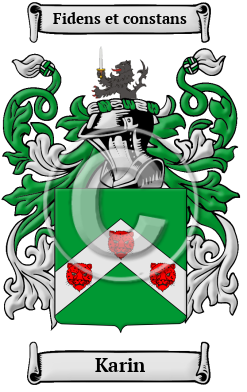
| ![Show Contents]() Karin History, Family Crest & Coats of Arms Karin History, Family Crest & Coats of Arms
- Origins Available:
Ireland
Etymology of KarinWhat does the name Karin mean? Gaelic, otherwise known as Early Modern Irish, was used in Ireland from around the year 1200 until the 18th century. It is from this language that we found the first references to the name Karin as Ó Ciarain or Mac Ciarain. These names are derived from the word "ciar," which means "black" or "dark brown." 1 Early Origins of the Karin familyThe surname Karin was first found in County Mayo (Irish: Maigh Eo) located on the West coast of the Republic of Ireland in the province of Connacht, where they held a family seat from ancient times. Early History of the Karin familyThis web page shows only a small excerpt of our Karin research. Another 87 words (6 lines of text) are included under the topic Early Karin History in all our PDF Extended History products and printed products wherever possible. Karin Spelling VariationsMany spelling variations of the surname Karin can be found in the archives. One reason for these variations is that ancient scribes and church officials recorded names as they were pronounced, often resulting in a single person being recorded under several different spellings. The different spellings that were found include Kieran, O'Kieran, Keiran, Keighran, O'Keiran, Kerin and many more. Early Notables of the Karin familyMore information is included under the topic Early Karin Notables in all our PDF Extended History products and printed products wherever possible. Migration of the Karin familyIrish families left their homeland in astonishing numbers during the 19th century in search of a better life. Although individual reasons vary, most of these Irish families suffered from extreme poverty, lack of work opportunities, and exorbitant rents in their homeland. Many decided to travel to Australia or North America in the hopes of finding greater opportunities and land. The Irish immigrants that came to North America initially settled on the East Coast, often in major centers such as Boston or New York. But like the many other cultures to settle in North America, the Irish traveled to almost any region they felt held greater promise; as a result, many Irish with gold fever moved all the way out to the Pacific coast. Others before that time left for land along the St. Lawrence River and the Niagara Peninsula, or the Maritimes as United Empire Loyalists, for many Irish did choose to side with the English during the American War of Independence. The earliest wave of Irish migration, however, occurred during the Great Potato Famine of the 1840s. An examination of early immigration and passenger lists has revealed many people bearing the Karin name: James, Patrick and Thomas, who Keiran arrived in Philadelphia between 1840 and 1860; John and Thomas Kieran settled in Philadelphia between 1858 and 1868. In Newfoundland, William Kearon, from Tallon, Waterford county, Ireland, was married in St. John'.
| Contemporary Notables of the name Karin (post 1700) | + |
- Julia Karin Ormond (b. 1965), English actress
- Karin Borner (1935-2025), Swiss competitive figure skater, represented Switzerland at the 1956 Winter Olympics in Cortina d'Ampezzo, won the bronze medal at the 1956 Richmond Trophy
- Karin Pettersen (b. 1964), Norwegian team handball player
- Karin Bucha (1906-1971), German writer
- Karin Maar-Fields McRobert (b. 1953), Australian women's basketball player who played on the Australian women's national basketball team from 1975 to 1985, inducted into the Australian Basketball Hall of Fame in 2010
- Karin Praxmarer (1944-2021), née Kusatz, an Austrian politician, member of the Freedom Party of Austria, she served in the National Council (1986 to 1996) and in 1999
- Karin Hoelzer, American veterinary researcher at Cornell University
- Karin Strenz (1967-2021), German politician who represented the CDU
- Karin Kock (1891-1976), Swedish politician and Professor of Economics
The motto was originally a war cry or slogan. Mottoes first began to be shown with arms in the 14th and 15th centuries, but were not in general use until the 17th century. Thus the oldest coats of arms generally do not include a motto. Mottoes seldom form part of the grant of arms: Under most heraldic authorities, a motto is an optional component of the coat of arms, and can be added to or changed at will; many families have chosen not to display a motto.
Motto: Fidens et constans
Motto Translation: Stand firm on trust.
- MacLysaght, Edward, The Surnames of Ireland. Ireland: Irish Academic Press, sixth edition, 1985. Print. (ISBN 0-7165-2366-3)
 |