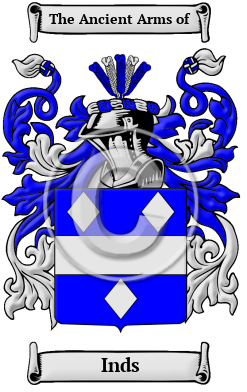
| ![Show Contents]() Inds History, Family Crest & Coats of Arms Inds History, Family Crest & Coats of Arms
Etymology of IndsWhat does the name Inds mean? Soon after the Norman Conquest of England in 1066, the name Inds was recognized on the island as a name for a person who was gentle or timid. The name Inds is derived from the Old English word hind, which refers to a female deer. 1 Early Origins of the Inds familyThe surname Inds was first found in Essex, where Cristiana Henry Hynde was listed in the Assize Rolls for 1285, and again in the Subsidy Rolls for Staffordshire in 1332. 1 Early History of the Inds familyThis web page shows only a small excerpt of our Inds research. Another 88 words (6 lines of text) covering the years 1550, 1557, 1569, 1586, 1606, 1629, 1648, 1649, 1651, 1652 and 1890 are included under the topic Early Inds History in all our PDF Extended History products and printed products wherever possible. Inds Spelling VariationsNorman surnames are characterized by a multitude of spelling variations. The frequent changes in surnames are largely due to the fact that the Old and Middle English languages lacked definite spelling rules. The introduction of Norman French to England, as well as the official court languages of Latin and French, also had pronounced influences on the spelling of surnames. Since medieval scribes and church officials recorded names as they sounded, rather than adhering to any specific spelling rules, it was common to find the same individual referred to with different spellings. The name has been spelled Hind, Hinde, Hynd, Hynde, Hynds, Hinds and others. Early Notables of the Inds familyWilliam Hinde (1569?-1629), English Puritan divine, born at Kendal, Westmoreland, about 1569, entered Queen's College, Oxford, in Michaelmas term 1586 as a servitor, but was elected successively tabarder and perpetual fellow. 2
Sir John Hynde (d. 1550), was an early English judge, of a family settled at Madingley in Cambridgeshire, and was educated at Cambridge. 2
John Hynde (fl. 1606), was an English romancer, probably grandson of Sir John Hynde, the judge [q. v.] 2
On the infamous side, James Hind (d. 1652), was an English highwayman, son of a saddler of Chipping Norton, Oxfordshire and was apprenticed to a butcher in that town...
Another 221 words (16 lines of text) are included under the topic Early Inds Notables in all our PDF Extended History products and printed products wherever possible. Migration of the Inds family to IrelandSome of the Inds family moved to Ireland, but this topic is not covered in this excerpt.
Another 57 words (4 lines of text) about their life in Ireland is included in all our PDF Extended History products and printed products wherever possible. Migration of the Inds familyMany English families emigrated to North American colonies in order to escape the political chaos in Britain. Unfortunately, many English families made the trip to the New World under extremely harsh conditions. Overcrowding on the ships caused the majority of the immigrants to arrive diseased, famished, and destitute from the long journey across the stormy Atlantic. Despite these hardships, many of the families prospered and went on to make invaluable contributions to the development of the cultures of the United States and Canada. Early North American immigration records have revealed a number of people bearing the name Inds or a variant listed above: William Hind who settled in Virginia in 1635; Isaac, John, Joseph and Mary Hind settled in Maryland in 1774; Robert Hinde settled in Virginia in 1635; James Hinde settled in Virginia in 1652.
- Reaney, P.H and R.M. Wilson, A Dictionary of English Surnames. London: Routledge, 1991. Print. (ISBN 0-415-05737-X)
- Smith, George (ed), Dictionary of National Biography. London: Smith, Elder & Co., 1885-1900. Print
 |