| ![Show Contents]() Imlay History, Family Crest & Coats of Arms Imlay History, Family Crest & Coats of Arms
Etymology of ImlayWhat does the name Imlay mean? The ancestry of the name Imlay dates from the ancient Anglo-Saxon culture of Britain. It comes from when the family lived in Yorkshire, where they derived the family name from Helmsley. It was in the West Riding of Yorkshire, but has been lost to modern maps. The place-name was probably derived from the Old English personal name Helm, and ley or leah, which were Old English words for "a clearing in the woods." The translation of the place-name was "clearing belonging to Helm." 1 Early Origins of the Imlay familyThe surname Imlay was first found in Yorkshire at Helmsley, a market-town and parish, and the head of a union, in the wapentake of Ryedale. The town dates back to the time of Richard I. 2 The Domesday Book of 1086 lists the town as Elmeslac. 3 Helmsley Castle (also known anciently as Hamlake) is a medieval castle originally constructed in wood around 1120 by Walter l'Espec (died 1153.) In Scotland, many of the family originated in Aberdeenshire where the first record was that of William de Elmysley in 1333. 4 Later, Thomas Elmyslie was burgess in Aberdeenshire in 1498 and William Elmislie was reidare at Rutbven in 1574. 5 In America, Imlaystown, founded in 1690, in New Jersey was the home to James Henderson Imlay (1754-1823) and perhaps Gilbert Imlay (1754-1828), but the latter may have been born in Upper Freehold, New Jersey. Alexander (1794-1847), George (c. 1794-1846) and Peter Imlay (1797-1881) were brothers born in Aberdeen, Scotland who emigrated to Sydney, Australia c. 1830. Early History of the Imlay familyThis web page shows only a small excerpt of our Imlay research. Another 223 words (16 lines of text) covering the years 1296, 1492, 1524, 1567, 1599, 1600, 1686, 1715, 1736, 1738, 1745, 1762, 1774, 1796, 1801, 1802, 1805 and 1825 are included under the topic Early Imlay History in all our PDF Extended History products and printed products wherever possible. Imlay Spelling VariationsSpelling variations in names were a common occurrence before English spelling was standardized a few hundred years ago. In the Middle Ages, even the literate spelled their names differently as the English language incorporated elements of French, Latin, and other European languages. Many variations of the name Imlay have been found, including Elmslie, Elmsley, Emsley, Elmesley, Helmsley, Emesley, Emesly, Ernele and many more. Early Notables of the Imlay familyJohn Elmsley (1762-1805), English-born, Chief Justice of Upper Canada (1796-1802) and later of Lower Canada (1802-1805.)
Peter Elmsley (1774-1825), was an English classical scholar born Hampstead, London.
Peter Elmsley or Elmsly (1736-1802)...
Another 30 words (2 lines of text) are included under the topic Early Imlay Notables in all our PDF Extended History products and printed products wherever possible.
| Imlay migration to the United States | + |
Families began migrating abroad in enormous numbers because of the political and religious discontent in England. Often faced with persecution and starvation in England, the possibilities of the New World attracted many English people. Although the ocean trips took many lives, those who did get to North America were instrumental in building the necessary groundwork for what would become for new powerful nations. Some of the first immigrants to cross the Atlantic and come to North America bore the name Imlay, or a variant listed above:
Imlay Settlers in United States in the 17th Century- Peter Patrick Imlay, who landed in Perth Amboy, NJ in 1683 6
| Contemporary Notables of the name Imlay (post 1700) | + |
- James Henderson Imlay (1764-1823), American educator, lawyer and politician, United States Representative from New Jersey (1797-1801)
- Chris Imlay (b. 1969), American rock and roll musician and graphic artist
- Gilbert Imlay (1754-1828), American businessman, author, and diplomat
- Frances Imlay (1794-1816), also known as Fanny Godwin and Frances Wollstonecraft, the daughter of the British feminist Mary Wollstonecraft and the American commercial speculator and diplomat Gilbert Imlay
- Peter Imlay (1797-1881), Scottish-born, Australian and New Zealand landowner and speculator
- George Imlay (1794-1846), Scottish-born, Australian landowner and speculator
- Alexander Imlay (1794-1847), Scottish-born, Australian landowner and speculator
- George Imlay Kidd (1909-1988), Scottish footballer
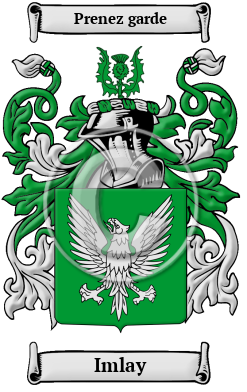
The motto was originally a war cry or slogan. Mottoes first began to be shown with arms in the 14th and 15th centuries, but were not in general use until the 17th century. Thus the oldest coats of arms generally do not include a motto. Mottoes seldom form part of the grant of arms: Under most heraldic authorities, a motto is an optional component of the coat of arms, and can be added to or changed at will; many families have chosen not to display a motto.
Motto: Prenez garde
Motto Translation: Take care.
- Mills, A.D., Dictionary of English Place-Names. Oxford: Oxford University Press, 1991. Print. (ISBN 0-19-869156-4)
- Lewis, Samuel, A Topographical Dictionary of England. Institute of Historical Research, 1848, Print.
- Williams, Dr Ann. And G.H. Martin, Eds., Domesday Book A Complete Translation. London: Penguin, 1992. Print. (ISBN 0-141-00523-8)
- Reaney, P.H and R.M. Wilson, A Dictionary of English Surnames. London: Routledge, 1991. Print. (ISBN 0-415-05737-X)
- Black, George F., The Surnames of Scotland Their Origin, Meaning and History. New York: New York Public Library, 1946. Print. (ISBN 0-87104-172-3)
- Filby, P. William, Meyer, Mary K., Passenger and immigration lists index : a guide to published arrival records of about 500,000 passengers who came to the United States and Canada in the seventeenth, eighteenth, and nineteenth centuries. 1982-1985 Cumulated Supplements in Four Volumes Detroit, Mich. : Gale Research Co., 1985, Print (ISBN 0-8103-1795-8)
 |