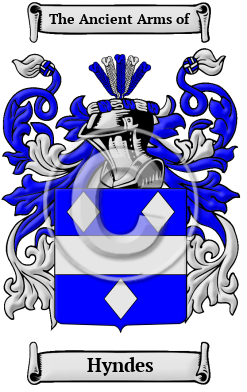
| ![Show Contents]() Hyndes History, Family Crest & Coats of Arms Hyndes History, Family Crest & Coats of Arms
Etymology of HyndesWhat does the name Hyndes mean? The name Hyndes comes from the ancient Norman culture that was established in Britain after the Conquest of 1066. It was a name for a person who was gentle or timid. The name Hyndes is derived from the Old English word hind, which refers to a female deer. 1 Early Origins of the Hyndes familyThe surname Hyndes was first found in Essex, where Cristiana Henry Hynde was listed in the Assize Rolls for 1285, and again in the Subsidy Rolls for Staffordshire in 1332. 1 Early History of the Hyndes familyThis web page shows only a small excerpt of our Hyndes research. Another 88 words (6 lines of text) covering the years 1550, 1557, 1569, 1586, 1606, 1629, 1648, 1649, 1651, 1652 and 1890 are included under the topic Early Hyndes History in all our PDF Extended History products and printed products wherever possible. Hyndes Spelling VariationsAnglo-Norman names are characterized by a multitude of spelling variations. When the Normans became the ruling people of England in the 11th century, they introduced a new language into a society where the main languages of Old and later Middle English had no definite spelling rules. These languages were more often spoken than written, so they blended freely with one another. Contributing to this mixing of tongues was the fact that medieval scribes spelled words according to sound, ensuring that a person's name would appear differently in nearly every document in which it was recorded. The name has been spelled Hind, Hinde, Hynd, Hynde, Hynds, Hinds and others. Early Notables of the Hyndes familyWilliam Hinde (1569?-1629), English Puritan divine, born at Kendal, Westmoreland, about 1569, entered Queen's College, Oxford, in Michaelmas term 1586 as a servitor, but was elected successively tabarder and perpetual fellow. 2
Sir John Hynde (d. 1550), was an early English judge, of a family settled at Madingley in Cambridgeshire, and was educated at Cambridge. 2
John Hynde (fl. 1606), was an English romancer, probably grandson of Sir John Hynde, the judge [q. v.] 2
On the infamous side, James Hind (d. 1652), was an English highwayman, son of a saddler of Chipping Norton, Oxfordshire and was apprenticed to a butcher in that town...
Another 221 words (16 lines of text) are included under the topic Early Hyndes Notables in all our PDF Extended History products and printed products wherever possible. Migration of the Hyndes family to IrelandSome of the Hyndes family moved to Ireland, but this topic is not covered in this excerpt.
Another 57 words (4 lines of text) about their life in Ireland is included in all our PDF Extended History products and printed products wherever possible. Migration of the Hyndes familyFor many English families, the political and religious disarray that plagued their homeland made the frontiers of the New World an attractive prospect. Thousands migrated, aboard cramped disease-ridden ships. They arrived sick, poor, and hungry, but were welcomed in many cases with far greater opportunity than at home in England. Many of these hardy settlers went on to make important contributions to the emerging nations in which they landed. Among early immigrants bearing the name Hyndes or a variant listed above were: William Hind who settled in Virginia in 1635; Isaac, John, Joseph and Mary Hind settled in Maryland in 1774; Robert Hinde settled in Virginia in 1635; James Hinde settled in Virginia in 1652.
- Reaney, P.H and R.M. Wilson, A Dictionary of English Surnames. London: Routledge, 1991. Print. (ISBN 0-415-05737-X)
- Smith, George (ed), Dictionary of National Biography. London: Smith, Elder & Co., 1885-1900. Print
 |