
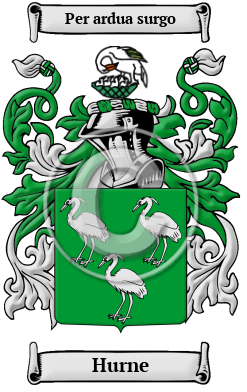
Show ContentsHurne History, Family Crest & Coats of Arms

Etymology of Hurne

What does the name Hurne mean?

Many Irish surnames can be traced back to their Gaelic forms. The name Hurne originally appeared in Gaelic as Ó hEachthigheirn or Ó hEachthigheirna, made up of the words "each" meaning "steed," and "thighearna," meaning "lord." This was first Anglicized O'Hagherin, which was later changed to O'Aherne before the prefix was eventually dropped. 1

Early Origins of the Hurne family

The surname Hurne was first found in County Clare (Irish: An Clár) located on the west coast of Ireland in the province of Munster, where they held a family seat as a Dalcassian sept from before the year 1000. However, with the disruptions of the Strongbow Invasion of 1172, they migrated southward to counties Cork and Waterford. In Waterford the name is predominantly Hearn and Hearne.

Early History of the Hurne family

This web page shows only a small excerpt of our Hurne research. Another 116 words (8 lines of text) covering the years 1420, 1566, 1754, 1769, 1797 and 1806 are included under the topic Early Hurne History in all our PDF Extended History products and printed products wherever possible.

Hurne Spelling Variations

During the Middle Ages, surnames were spelt by scribes solely based on how it sounded, one's name could have been recorded many different ways during the life of its bearer. Numerous spelling variations were revealed in the search for the origin of the name Hurne family name. Variations found include O'Aherne, O'Ahern, Hearne, O'Heffron, Haveran, Hayveren and many more.

Early Notables of the Hurne family

More information is included under the topic Early Hurne Notables in all our PDF Extended History products and printed products wherever possible.


Hurne migration to Australia +

Emigration to Australia included the Second Fleet of convicts, tradespeople and early settlers. Early immigrants include:

Second Fleet
  • Mr. Plunkit Hurne, (Plunket), British settler convicted in Middlesex, England in 1790, sentenced to 7 years for highway robbery, transported aboard the ship "Active" leaving in 1790 arriving in New South Wales, Australia in 1791 2


The Hurne Motto +

The motto was originally a war cry or slogan. Mottoes first began to be shown with arms in the 14th and 15th centuries, but were not in general use until the 17th century. Thus the oldest coats of arms generally do not include a motto. Mottoes seldom form part of the grant of arms: Under most heraldic authorities, a motto is an optional component of the coat of arms, and can be added to or changed at will; many families have chosen not to display a motto.

Motto: Per ardua surgo
Motto Translation: I rise through difficulties.


  1. MacLysaght, Edward, Irish Families Their Names, Arms and Origins 4th Edition. Dublin: Irish Academic, 1982. Print. (ISBN 0-7165-2364-7)
  2. Convict Records of Australia. Retrieved 4th February 2021 from https://convictrecords.com.au/ships


Houseofnames.com on Facebook