| ![Show Contents]() Humme History, Family Crest & Coats of Arms Humme History, Family Crest & Coats of Arms
Etymology of HummeWhat does the name Humme mean? The ancestors of the surname Humme were thought to have been a Boernician family in ancient Scotland. They lived in Berwickshire. They held the barony of Home from very early times and possibly predate the Norman Conquest in 1066. The Home family is part of a noble lineage descending from the Earls of Dunbar, and the family of the Earl of Northumberland, the great Gospatrick, a descendent of the Kings of Bernicia. They first appear in the records in 1268, when William of Home appeared on a charter. They next appear (as so many of the prominent Scottish families do) in 1296, when Geffrai de Home of Lanarkshire swore an oath of allegiance (in the Ragman Rolls) to King Edward I of England after that king's brief conquest of Scotland. Early Origins of the Humme familyThe surname Humme was first found in Berwickshire an ancient county of Scotland, presently part of the Scottish Borders Council Area, located in the eastern part of the Borders Region of Scotland. They held the barony of Home from very early times, and possibly predate the Norman Conquest in 1066. There were many branches of the Humme family including the Homes of Cowdenknowes, the Homes of Wedderburn, the Homes of Manderston, the Homes of Renton, the Homes of Kames, and the Homes of Blackadder. Early History of the Humme familyThis web page shows only a small excerpt of our Humme research. Another 132 words (9 lines of text) covering the years 1456, 1468, 1506, 1560, 1569, 1604, 1609, 1641, 1645, 1648, 1671, 1696, 1698, 1702, 1724, 1797 and 1890 are included under the topic Early Humme History in all our PDF Extended History products and printed products wherever possible. Humme Spelling VariationsBefore the first dictionaries and printing presses went into use in the last few hundred years, spelling, particularly of names, was a largely intuitive matter. Consequently, many spelling variations occur in even the simplest names from the Middle Ages. Humme has been spelled Humes, Hum, Humme, Humm, Homes and others. Early Notables of the Humme familySir Alexander Home or Hume (d. 1456), of Home, Warden of the Marches, the eldest son of Sir Alexander Home of Dunglass 1; Alexander Home, 2nd Lord Home (c.1468-1506), a Scottish nobleman and soldier, Lord Chamberlain of Scotland and Warden of the Eastern March; Alexander Hume (c.1560-c.1609), Scottish poet; Tobias Hume (c.1569-1645), a Scottish composer, viol player and soldier; George Home, created Baron Hume of Berwick in 1604...
Another 68 words (5 lines of text) are included under the topic Early Humme Notables in all our PDF Extended History products and printed products wherever possible. Migration of the Humme family to IrelandSome of the Humme family moved to Ireland, but this topic is not covered in this excerpt.
Another 89 words (6 lines of text) about their life in Ireland is included in all our PDF Extended History products and printed products wherever possible.
| Humme migration to the United States | + |
The east coasts of the United States and Canada are still populated by many of the descendents of the Boernician-Scottish families who made that great crossing. They distributed themselves evenly when they first arrived, but at the time of the War of Independence those who remained loyal to England went north to Canada as United Empire Loyalists. This century, many of their ancestors have recovered their past heritage through highland games and other Scottish functions in North America. Many of these hardy settlers went on to make important contributions to the emerging nations in which they landed. Investigation of the origins of family names on the North American continent has revealed that many immigrants bearing the name Humme or a variant listed above:
Humme Settlers in United States in the 19th Century- Bernh Theodor Humme, who landed in America in 1844 2
- Marianne Humme, who arrived in America in 1844 2
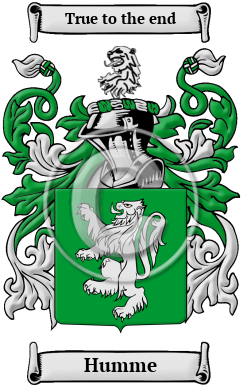
The motto was originally a war cry or slogan. Mottoes first began to be shown with arms in the 14th and 15th centuries, but were not in general use until the 17th century. Thus the oldest coats of arms generally do not include a motto. Mottoes seldom form part of the grant of arms: Under most heraldic authorities, a motto is an optional component of the coat of arms, and can be added to or changed at will; many families have chosen not to display a motto.
Motto: True to the end
- Smith, George (ed), Dictionary of National Biography. London: Smith, Elder & Co., 1885-1900. Print
- Filby, P. William, Meyer, Mary K., Passenger and immigration lists index : a guide to published arrival records of about 500,000 passengers who came to the United States and Canada in the seventeenth, eighteenth, and nineteenth centuries. 1982-1985 Cumulated Supplements in Four Volumes Detroit, Mich. : Gale Research Co., 1985, Print (ISBN 0-8103-1795-8)
 |