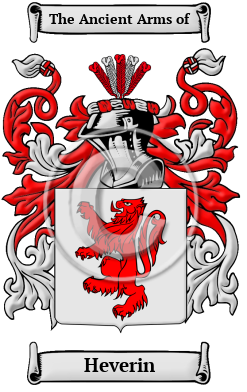
| ![Show Contents]() Heverin History, Family Crest & Coats of Arms Heverin History, Family Crest & Coats of Arms
Etymology of HeverinWhat does the name Heverin mean? The illustrious and ancient name Heverin claims Havering-atte-Bower, in East London as its point of origin. Originally recorded as Haueringas in the Domesday Book of 1086, 1 it became known as Hauering atte Bower in 1272. Literally the place name meant "settlement of the family or followers of a man called Haefer," from the Old English personal name + "-ingas." The affix means "at the bower or royal residence" from the Old English word "bur." 2 Early Origins of the Heverin familyThe surname Heverin was first found in Essex at Havering atte Bower, where Richard Haveryng held estates and was listed in the Feet of Fines for 1343. In the same year, Roger de Havering alias atte Sele was listed in London and later, Richard Haveryng was recorded in Dorset in 1468. 3 Today in East London, the London Borough of Havering forms part of Outer London. John de Havering (died 1309), Lord of Grafton, was an English military and civil servant who was considered to be one of the most experienced administrators of King Edward I. He served as Seneschal of Gascony and as Justiciar of North Wales, having descended from Richard de Havering (died 1267), who was steward of the estates of Simon de Montfort, 6th Earl of Leicester. His son, Richard de Havering (or Richard de Haverings) (died 1341) was a medieval Roman Catholic clergyman who briefly became Archbishop of Dublin. The Havering hoard is a hoard of 453 late Bronze-age (900 to 800 BCE) artifacts found at a site overlooking the River Thames in Rainham, London, in 2018. It is the largest bronze-age hoard to be found in London and the third-largest in the United Kingdom. The finds included weapons, tools and ingots, but only a small quantity of jewelry. Early History of the Heverin familyThis web page shows only a small excerpt of our Heverin research. Another 145 words (10 lines of text) covering the years 1164, 1510 and 1600 are included under the topic Early Heverin History in all our PDF Extended History products and printed products wherever possible. Heverin Spelling VariationsCornish surnames are characterized by a multitude of spelling variations. The frequent changes in surnames are due to the fact that the Old and Middle English languages lacked definite spelling rules. The official court languages, which were Latin and French, were also influential on the spelling of a surname. Since the spelling of surnames was rarely consistent in medieval times, and scribes and church officials recorded names as they sounded rather than adhering to any specific spelling rules, it was common to find the same individual referred to with different spellings of their surname in the ancient chronicles. Moreover, a large number of foreign names were brought into England, which accelerated and accentuated the alterations to the spelling of various surnames. Lastly, spelling variations often resulted from the linguistic differences between the people of Cornwall and the rest of England. The Cornish spoke a unique Brythonic Celtic language which was first recorded in written documents during the 10th century. However, they became increasingly Anglicized, and Cornish became extinct as a spoken language in 1777, although it has been revived by Cornish patriots in the modern era. The name has been spelled Havering, Haverin, Hafering, Hevering, Heverin and others. Early Notables of the Heverin familyMore information is included under the topic Early Heverin Notables in all our PDF Extended History products and printed products wherever possible. Migration of the Heverin familyIn the immigration and passenger lists a number of early immigrants bearing the name Heverin were found: the name represented in many forms and recorded from the mid 17th century in the great migration from Europe. Migrants settled in the eastern seaboard from Newfoundland, to Maine, to Virginia, the Carolinas, and to the islands..
- Williams, Dr Ann. And G.H. Martin, Eds., Domesday Book A Complete Translation. London: Penguin, 1992. Print. (ISBN 0-141-00523-8)
- Mills, A.D., Dictionary of English Place-Names. Oxford: Oxford University Press, 1991. Print. (ISBN 0-19-869156-4)
- Reaney, P.H and R.M. Wilson, A Dictionary of English Surnames. London: Routledge, 1991. Print. (ISBN 0-415-05737-X)
 |