| ![Show Contents]() Herpart History, Family Crest & Coats of Arms Herpart History, Family Crest & Coats of Arms
Etymology of HerpartWhat does the name Herpart mean? Herpart is a name that was brought to England by the ancestors of the Herpart family when they emigrated following the Norman Conquest of 1066. The name Herpart comes from the Germanic personal name Herbert. It is also an Old French given name derived from the Old German name Hariberct or Her(e)bert. This Germanic name contains the elements harja which means army and berhta, which means bright. The name was first borne by St. Herbert or Herebert (d. 687), who was an early "hermit, resided on the island in Derwentwater which still bears his name. He was a disciple and close friend of St. Cuthbert, to whom he paid an annual visit for spiritual advice. The two friends both died on 20 March 687, Herebert suffering much from sickness before his death." 1 "The noble Herberts descend from Herbert, Count of Vemandois, who came hither with the Conqueror, and was chamberlain to William Rufus. Collins says: 'the genealogists deduce the family from Herbert, a natural son of King Henry I., but I think it more evident that Henry Fitz-Herbert, chamberlain to the said king, was ancestor to all of the name of Herbert.' " 2 Early Origins of the Herpart familyThe surname Herpart was first found in the Domesday Book of 1086 where the Latin forms of the name, Herbertus and Hereberd were recorded. 3 Herbertus capellanus was listed in Suffolk in 1148-1156. William Herebert was the first listing not in Latin in Dorset in 1206. Richard Herbert, Herebert, Herberd was found in the Assize Rolls for Worcester in 1221 and Johannes Herberti was found in Norfolk in 1230. 4 In Scotland, "about the year 1200 Herbert filius Herberti de Camera granted a half carucate in Dunipace to the Abbey of Cambuskenneth. One or other of these Herberts most probably gave name to Herbertshire near Denny, Stirlingshire. Herbert, third abbot of Selkirk, was bishop of Glasgow, 1147-1164." 5 Herbert of Bosham (fl. 1162-1186), was an early English biographer, "has told us himself that he was born at the place whence he took his name, Bosham, or, as he spells it, Boseham, in Sussex. " 1 Early History of the Herpart familyThis web page shows only a small excerpt of our Herpart research. Another 106 words (8 lines of text) covering the years 1206, 1230, 1333, 1423, 1468, 1469, 1550, 1572, 1583, 1587, 1593, 1595, 1598, 1606, 1617, 1621, 1625, 1626, 1640, 1644, 1646, 1648, 1655, 1659, 1663, 1667, 1673, 1682, 1685, 1687, 1689, 1690, 1691, 1696, 1716, 1756, 1797, 1821, 1840, 1866, 1880 and 1901 are included under the topic Early Herpart History in all our PDF Extended History products and printed products wherever possible. Herpart Spelling VariationsBefore the last few hundred years the English language had no fixed system of spelling rules. For that reason, spelling variations occurred commonly in Anglo Norman surnames. Over the years, many variations of the name Herpart were recorded, including Herbert, Herbit, Herbutt and others. Early Notables of the Herpart familyWilliam Herbert, 1st Earl of Pembroke (c. 1423-1469), known as "Black William", was the son of William ap Thomas, founder of Raglan Castle; Sir John Herbert (1550-1617), Welsh lawyer and diplomat, Secretary of State under Elizabeth I and James I; Sir Henry Herbert (1595-1673), Master of the Revels to both King Charles I and King Charles II; Sir Richard Herbert; William Herbert, 1st Baron Powis (1572-1655) was a Welsh politician; Percy Herbert, 2nd Baron Powis (1598-1667), an English writer and politician; George Herbert (1593-1663), an English (Welsh born) poet and academic, who became the rector of Bemerton, near Salisbury; Sir Thomas...
Another 116 words (8 lines of text) are included under the topic Early Herpart Notables in all our PDF Extended History products and printed products wherever possible. Migration of the Herpart family to IrelandSome of the Herpart family moved to Ireland, but this topic is not covered in this excerpt.
Another 191 words (14 lines of text) about their life in Ireland is included in all our PDF Extended History products and printed products wherever possible. Migration of the Herpart familyThe unstable environment in England at this time caused numerous families to board ships and leave in search of opportunity and freedom from persecution abroad in places like Ireland, Australia, and particularly the New World. The voyage was extremely difficult, however, and only taken at great expense. The cramped conditions and unsanitary nature of the vessels caused many to arrive diseased and starving, not to mention destitute from the enormous cost. Still opportunity in the emerging nations of Canada and the United States was far greater than at home and many went on to make important contributions to the cultures of their adopted countries. An examination of many early immigration records reveals that people bearing the name Herpart arrived in North America very early: Elizabeth Herbert, who settled in Barbados in 1671; John Herbert settled in Salem Massachusetts in 1630; Thomas Herbert settled in Virginia in 1651; William Herbert and his wife Elizabeth settled in Barbados in 1679.
The motto was originally a war cry or slogan. Mottoes first began to be shown with arms in the 14th and 15th centuries, but were not in general use until the 17th century. Thus the oldest coats of arms generally do not include a motto. Mottoes seldom form part of the grant of arms: Under most heraldic authorities, a motto is an optional component of the coat of arms, and can be added to or changed at will; many families have chosen not to display a motto.
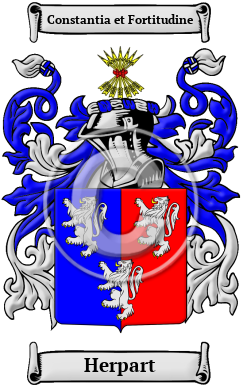
Motto: Constantia et Fortitudine
Motto Translation: By constancy and fortitude.
- Smith, George (ed), Dictionary of National Biography. London: Smith, Elder & Co., 1885-1900. Print
- Lower, Mark Anthony, Patronymica Britannica, A Dictionary of Family Names of the United Kingdom. London: John Russel Smith, 1860. Print.
- Williams, Dr Ann. And G.H. Martin, Eds., Domesday Book A Complete Translation. London: Penguin, 1992. Print. (ISBN 0-141-00523-8)
- Reaney, P.H and R.M. Wilson, A Dictionary of English Surnames. London: Routledge, 1991. Print. (ISBN 0-415-05737-X)
- Black, George F., The Surnames of Scotland Their Origin, Meaning and History. New York: New York Public Library, 1946. Print. (ISBN 0-87104-172-3)
 |