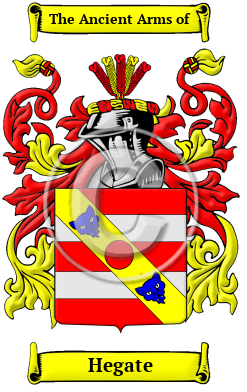
| ![Show Contents]() Hegate History, Family Crest & Coats of Arms Hegate History, Family Crest & Coats of Arms
Early Origins of the Hegate familyThe surname Hegate was first found in Middlesex at Highgate, a town and chapelry, partly in the parishes of St. Pancras and Islington, but chiefly in that of Hornsey, union of Edmonton. "According to Camden and other authorities, the hamlet of Highgate derived its name from the high-gate, or gate upon the hill, erected by the Bishop of London, on or very near the site of the present Gatehouse inn, about 500 years ago, when the high road over the hill was formed. But in a recent work drawn up on the invitation of the Highgate Literary Institution, it is supposed, with some probability, that the name (which in an ancient record is written Hygate), is deducible from Hy, a syllable in the British language, perhaps corrupted from Hu, a cap, and implying also Episcopal, and Gate, an entrance or way. " 1 In the bordering county of Essex, we found the variant Mygate and Mygatt. From this branch, Deacon Jospeh Mygatt emigrated to the Massachusetts Bay Colony about 1634, settling in Cambridge by August 1634. Further to the north in Scotland, the name is "an old surname about Glasgow. Of local origin, perhaps from Highgate, near Beith, Ayrshire. Highet is a variant. Johne Hechet was burgess of Glasgow in 1527. William Higait or Hegait, notary in Glasgow, 1547-55." 2 As the reader will note, the Scottish records are quite late in comparison to the Middlesex reference, so one can presume some of the family migrated from Middlesex to Scotland. Early History of the Hegate familyThis web page shows only a small excerpt of our Hegate research. Another 193 words (14 lines of text) covering the years 1103, 1177, 1510, 1550, 1560, 1563, 1564, 1570, 1574, 1581, 1586, 1590, 1600, 1609, 1625, 1675 and 1820 are included under the topic Early Hegate History in all our PDF Extended History products and printed products wherever possible. Hegate Spelling VariationsUntil quite recently, the English language has lacked a definite system of spelling rules. Consequently, Anglo-Saxon surnames are characterized by a multitude of spelling variations. Changes in Anglo-Saxon names were influenced by the evolution of the English language, as it incorporated elements of French, Latin, and other languages. Although Medieval scribes and church officials recorded names as they sounded, so it is common to find one person referred to by several different spellings of his surname, even the most literate people varied the spelling of their own names. Variations of the name Hegate include Highgate, Higate, Hygate, Higgat, Higgett, Higgatt, Higget, Hygate, Hygat, Hyget, Hygett, Hygatt, Hegate, Hegatt and many more. Early Notables of the Hegate familyWilliam Hegat (fl. 1600), Scottish professor at Bordeaux, a native of Glasgow. "Several Hiegaits are mentioned in connection with Glasgow between 1570 and 1590. If the ascription to Hegat of the ‘Pædagogiæ’ is correct, he must have gone to France before 1563 as a very young man. Dempster, who knew him well, says that after teaching at Poitiers, Paris, Lisieux...
Another 60 words (4 lines of text) are included under the topic Early Hegate Notables in all our PDF Extended History products and printed products wherever possible. Migration of the Hegate familySearching for a better life, many English families migrated to British colonies. Unfortunately, the majority of them traveled under extremely harsh conditions: overcrowding on the ships caused the majority of the immigrants to arrive diseased, famished, and destitute from the long journey across the ocean. For those families that arrived safely, modest prosperity was attainable, and many went on to make invaluable contributions to the development of the cultures of the new colonies. Research into the origins of individual families in North America revealed records of the immigration of a number of people bearing the name Hegate or a variant listed above: the name represented in many forms and recorded from the mid 17th century in the great migration from Europe. Migrants settled in the eastern seaboard from Newfoundland, to Maine, to Virginia, the Carolinas, and to the islands..
- Lewis, Samuel, A Topographical Dictionary of England. Institute of Historical Research, 1848, Print.
- Black, George F., The Surnames of Scotland Their Origin, Meaning and History. New York: New York Public Library, 1946. Print. (ISBN 0-87104-172-3)
 |