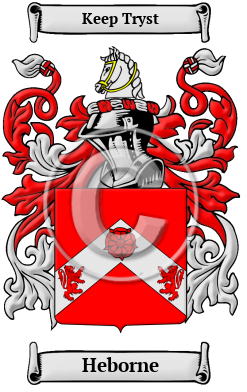
| ![Show Contents]() Heborne History, Family Crest & Coats of Arms Heborne History, Family Crest & Coats of Arms
Etymology of HeborneWhat does the name Heborne mean? The rich saga of the Heborne family begins in ancient Scotland among the clans of the Boernician tribe. They lived in Durham but moved northward in 1329 to Chillingham in Northumberland, where they lived in the village of Hebburn in the parish of Chillingham. 1 Early Origins of the Heborne familyThe surname Heborne was first found in Northumberland. Thomas de Heburn was on record in the Assize Rolls for that county in 1279. 2 They prospered here from 1271 until the 18th century, when the family line ended with an heiress. Adam de Hepburn (de Hylburne) was the first of the line. 3 One version of the tale goes that Hepburn was a prisoner of the Earl of March, who freed him and granted him lands for 'good and faithful service' after he saved the Earl's life from a feral (wild) horse. These lands were in East Lothian and the family spent the next several centuries aggressively acquiring new lands. 3 Early History of the Heborne familyThis web page shows only a small excerpt of our Heborne research. Another 125 words (9 lines of text) covering the years 1432, 1467, 1479, 1483, 1497, 1508, 1512, 1513, 1522, 1536, 1556, 1563, 1568, 1578, 1598, 1612, 1636, 1637 and 1672 are included under the topic Early Heborne History in all our PDF Extended History products and printed products wherever possible. Heborne Spelling VariationsIn the many years before the invention of the printing press and the first dictionaries, names and other words were spelled according to sound, often differently with each person who wrote them. Spelling variations of Heborne include Heighborne, Haybourne, Haybourn, Haybirn, Haybyrne, Heighburn, Heighbyrne, Heighbirn, Hepboyrne, Hepbirn, Hepbyrne, Hepburn, Heighbourne, Heyburn, Hebborne, Hebbourne, Hebbirn, Hebbyrne, Hebboorne and many more. Early Notables of the Heborne familyAdam Hepburn, Master of Hailes (c. 1432-1479), Sheriff of Berwickshire (1467); Sir Patrick Hepburn of Dunsyre, 1st Lord Hailes (died 1483) was the feudal lord of Hailes and its castle in Haddingtonshire and a Lord of Parliament; Patrick Hepburn, Patrick Hepburn, 3rd Lord Hailes and 1st Earl of Bothwell (died 1508), Lord High Admiral of Scotland. He was the eldest son of Adam, second lord Hailes, and Helen, eldest daughter of Alexander, first lord Home. 4
Patrick Hepburn third Earl of Bothwell (1512?-1556), was the only son of Adam, second earl of Bothwell.
Adam Hepburn of Craggis (died 1513), Master of the...
Another 210 words (15 lines of text) are included under the topic Early Heborne Notables in all our PDF Extended History products and printed products wherever possible. Migration of the Heborne family to IrelandSome of the Heborne family moved to Ireland, but this topic is not covered in this excerpt.
Another 31 words (2 lines of text) about their life in Ireland is included in all our PDF Extended History products and printed products wherever possible. Migration of the Heborne familyIn many cases, the ancestors of many of these Boernician-Scottish people are just now learning of their Scottish heritage. Since the trip was so arduous, and many were fleeing from poverty itself, settlers brought little with them and often had nothing of their personal history to hand down to their children. Clan societies and highland games have helped to correct this problem in the 20th century. Early immigration records have shown some of the first Hebornes to arrive on North American shores: George, Anne, Rebecca, and Anna Hepborne, who all arrived in Boston in 1635; Thomas Hepburn, who settled in Baltimore in 1792; and Francis Hepbourne settled in Maryland in 1769..
The motto was originally a war cry or slogan. Mottoes first began to be shown with arms in the 14th and 15th centuries, but were not in general use until the 17th century. Thus the oldest coats of arms generally do not include a motto. Mottoes seldom form part of the grant of arms: Under most heraldic authorities, a motto is an optional component of the coat of arms, and can be added to or changed at will; many families have chosen not to display a motto.
Motto: Keep Tryst
- Smith, Eldson Coles, New Dictionary of American Family Names New York: Harper & Row, 1956. Print
- Reaney, P.H and R.M. Wilson, A Dictionary of English Surnames. London: Routledge, 1991. Print. (ISBN 0-415-05737-X)
- Black, George F., The Surnames of Scotland Their Origin, Meaning and History. New York: New York Public Library, 1946. Print. (ISBN 0-87104-172-3)
- Smith, George (ed), Dictionary of National Biography. London: Smith, Elder & Co., 1885-1900. Print
 |