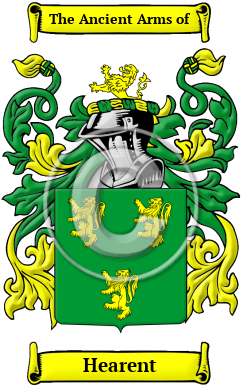
| ![Show Contents]() Hearent History, Family Crest & Coats of Arms Hearent History, Family Crest & Coats of Arms
- Origins Available:
Ireland
Etymology of HearentWhat does the name Hearent mean? Gaelic, otherwise known as Early Modern Irish, was used in Ireland from around the year 1200 until the 18th century. It is from this language that we found the first references to the name Hearent as Ó hOdhrain, which is derived from the word odhar, which means dun-colored. 1 Early Origins of the Hearent familyThe surname Hearent was first found in County Galway (Irish: Gaillimh) part of the province of Connacht, located on the west coast of the Island, where they held a family seat from ancient times. This distinguished tribe was descended from Eochy Moyvane who was the 124th monarch of Ireland, and from whom was descended King Niall of the Nine Hostages. King Niall was perhaps Ireland's greatest Commander King who was instrumental in routing the Romans from the British Isles. This group of tribes were known as the Septs of the Hy-Niall, and they were Chiefs of the territories in Ulster, Meath and Connacht. Early History of the Hearent familyThis web page shows only a small excerpt of our Hearent research. Another 91 words (6 lines of text) are included under the topic Early Hearent History in all our PDF Extended History products and printed products wherever possible. Hearent Spelling VariationsIrish names were rarely spelled consistently in the Middle Ages. Spelling variations of the name Hearent dating from that time include Haren, Horan, Harhan, Haran, O'Horan, O'Hourahan, O'Horahan, O'Haren, O'Harhan, O'Haran, O'Hanran and many more. Early Notables of the Hearent familyMore information is included under the topic Early Hearent Notables in all our PDF Extended History products and printed products wherever possible. Migration of the Hearent familyThe 19th century saw a great wave of Irish families leaving Ireland for the distant shores of North America and Australia. These families often left their homeland hungry, penniless, and destitute due to the policies of England. Those Irish immigrants that survived the long sea passage initially settled on the eastern seaboard of the continent. Some, however, moved north to a then infant Canada as United Empire Loyalists after ironically serving with the English in the American War of Independence. Others that remained in America later joined the westward migration in search of land. The greatest influx of Irish immigrants, though, came to North America during the Great Potato Famine of the late 1840s. Thousands left Ireland at this time for North America, and those who arrived were immediately put to work building railroads, coal mines, bridges, and canals. In fact, the foundations of today's powerful nations of the United States and Canada were to a larger degree built by the Irish. Archival documents indicate that members of the Hearent family relocated to North American shores quite early: Edward Horan who settled in Pennsylvania in 1773; Michael, Eliza and Michael Horan junior landed in Quebec in 1848; John, Michael and Simon Horan settled in New York state between 1803 and 1811.
- MacLysaght, Edward, The Surnames of Ireland. Ireland: Irish Academic Press, sixth edition, 1985. Print. (ISBN 0-7165-2366-3)
 |