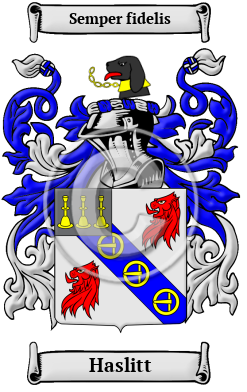
| ![Show Contents]() Haslitt History, Family Crest & Coats of Arms Haslitt History, Family Crest & Coats of Arms
Etymology of HaslittWhat does the name Haslitt mean? The roots of the Anglo-Saxon name Haslitt come from when the family resided in Surrey, where the name was derived from the term: 'at the hazel head,' i.e. one who dwelt at the head of the hazel wood. 1 "Hazelhead narrowed itself into Haslet, &c. Hazlehead is a hamlet in the parish of Thurlstone, West Riding of Yorkshire." 1 "Hæslett, is a common term in Essex, Kent and Surrey." 2 Early Origins of the Haslitt familyThe surname Haslitt was first found in Surrey where John Haselette was recorded in the Subsidy Rolls of 1332. The following year, William atte Hasellette was listed in 1333. Later again, William Hesilheued was listed as a Freeman of York in 1421. 2 Early History of the Haslitt familyThis web page shows only a small excerpt of our Haslitt research. Another 138 words (10 lines of text) covering the years 1172, 1327, 1333, 1455, 1487, 1887 and 1890 are included under the topic Early Haslitt History in all our PDF Extended History products and printed products wherever possible. Haslitt Spelling VariationsThe English language only became standardized in the last few centuries; therefore,spelling variations are common among early Anglo-Saxon names. As the form of the English language changed, even the spelling of literate people's names evolved. Haslitt has been recorded under many different variations, including Hazlet, Hazlett, Hazlitt, Hasslet, Hasslett, Hazlit, Haslitt, Hezlit, Hezlitt, Hezlett, Hezlet, Heaslitt, Heaslett, Hazled, Hazelhead, Hasslitt, Aslett, Azlett, Astlett and many more. Early Notables of the Haslitt familyMore information is included under the topic Early Haslitt Notables in all our PDF Extended History products and printed products wherever possible. Migration of the Haslitt family to IrelandSome of the Haslitt family moved to Ireland, but this topic is not covered in this excerpt.
Another 141 words (10 lines of text) about their life in Ireland is included in all our PDF Extended History products and printed products wherever possible. Migration of the Haslitt familyFor many English families, the political and religious disarray that shrouded England made the far away New World an attractive prospect. On cramped disease-ridden ships, thousands migrated to those British colonies that would eventually become Canada and the United States. Those hardy settlers that survived the journey often went on to make important contributions to the emerging nations in which they landed. Analysis of immigration records indicates that some of the first North American immigrants bore the name Haslitt or a variant listed above: James Hazlet, who settled in Pennsylvania in 1787; James Haslet, who came to Pennsylvania in 1773; Samuel Haslet, who settled in Philadelphia in 1789; Henry Haslet, who was on record in America in 1795.
The motto was originally a war cry or slogan. Mottoes first began to be shown with arms in the 14th and 15th centuries, but were not in general use until the 17th century. Thus the oldest coats of arms generally do not include a motto. Mottoes seldom form part of the grant of arms: Under most heraldic authorities, a motto is an optional component of the coat of arms, and can be added to or changed at will; many families have chosen not to display a motto.
Motto: Semper fidelis
Motto Translation: Always faithful.
- Bardsley, C.W, A Dictionary of English and Welsh Surnames: With Special American Instances. Wiltshire: Heraldry Today, 1901. Print. (ISBN 0-900455-44-6)
- Reaney, P.H and R.M. Wilson, A Dictionary of English Surnames. London: Routledge, 1991. Print. (ISBN 0-415-05737-X)
 |