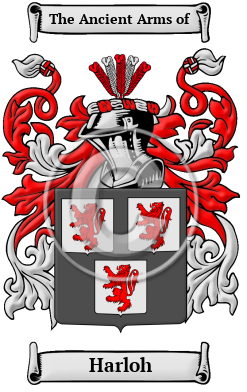
| ![Show Contents]() Harloh History, Family Crest & Coats of Arms Harloh History, Family Crest & Coats of Arms
Etymology of HarlohWhat does the name Harloh mean? The roots of the Anglo-Saxon name Harloh come from when the family resided in Harlow, a parish, in the union of Epping, hundred of Harlow, S. division of the county of Essex. 1 The parish dates to pre-Conquest times when it was first recorded as Herlawe in 1045. 2 A few years later after the Norman Conquest, the parish was recorded as Herlaua in the Domesday Book of 1086. 3 Literally the place name means "mound of hill associated with an army (perhaps Viking)," from the Old English words "here" + "Hlaw." 2 Harlow-Hill is "a township, in the parish of Ovingham, union of Castle ward, E. division of Tindale ward, S. division of Northumberland," and has a similar origin, having derived from "a corruption of Hare-law, 'the hill or station of the army,'" 1 In this later case, this township dates back to 1242 when it was known as Hirlawe. 2 Early Origins of the Harloh familyThe surname Harloh was first found in Essex where Richard de Herlawe was listed in the Hundredorum Rolls of 1273. The same rolls listed Nicholas de Herlawe, Northamptonshire. 4 While Essex is the generally accepted place of origin of the name, we did find an earlier entry at Bury St Edmunds, Suffolk, Osbern de Herlaue in 1121. The same surname was also found in Hertfordshire in 1205, Thomas de Herlaue. Up to the north in Yorkshire, Walter de Harlow was listed there in the Subsidy Rolls of 1327 and in 1442, Thomas Harlowe was found in the Assize Rolls for London in 1442. 5 The Harlaw variant was typical of Scotland and there, it was "of territorial or local origin from some place named Harlaw near the Border. There is a Harlaw Muir in Peeblesshire, and there appears to have been a Harlawbanks there also. A vill and lands of Hairlaw in Midlothian is recorded in 1565 (Retours). William de Harlau witnessed a charter in favor of the Abbey of Scone c. 1204-1241, and Richard de Harlau and William de Harlau were on an inquest held at the chapel of St. Katherine, Bavelay, near Edinburgh, in 1280. William de Harlau was on an assize at Berwick in 1296, and Matthew de Harlawe rendered homage in the same year." 6 This noted author points toward a possible linkage the the Essex and Northumberland families with the variant Harle in Scotland: "probably derived his name from Kirkharle in Northumberland. The Harles of Kirkharle owned much property in Northumberland." 6 The reader should note the "Kirk" prefix for this last entry denotes "church" in Scottish Gaelic. Early History of the Harloh familyThis web page shows only a small excerpt of our Harloh research. Another 146 words (10 lines of text) covering the years 1273, 1528, 1566, 1599, 1601, 1604, 1609, 1647, 1689, 1690, 1692, 1741 and 1795 are included under the topic Early Harloh History in all our PDF Extended History products and printed products wherever possible. Harloh Spelling VariationsThe English language only became standardized in the last few centuries; therefore,spelling variations are common among early Anglo-Saxon names. As the form of the English language changed, even the spelling of literate people's names evolved. Harloh has been recorded under many different variations, including Harlow, Harlowe and others. Early Notables of the Harloh familyThomas Harlowe (d. 1741), English Captain in the Navy who on 19 March 1689-1690 appointed to command the Smyrna Merchant, hired ship, and took post from that date. In the following year he commanded the Burford of 70 guns, in the grand fleet under Admiral Russell; and again in 1692, when...
Another 50 words (4 lines of text) are included under the topic Early Harloh Notables in all our PDF Extended History products and printed products wherever possible. Migration of the Harloh familyFor many English families, the political and religious disarray that shrouded England made the far away New World an attractive prospect. On cramped disease-ridden ships, thousands migrated to those British colonies that would eventually become Canada and the United States. Those hardy settlers that survived the journey often went on to make important contributions to the emerging nations in which they landed. Analysis of immigration records indicates that some of the first North American immigrants bore the name Harloh or a variant listed above: John Harlow, who arrived in Virginia in 1619, before the "Mayflower"; Anthony Harlow settled in Virginia in 1623; Mary Harlow settled in Maryland in 1722.
- Lewis, Samuel, A Topographical Dictionary of England. Institute of Historical Research, 1848, Print.
- Mills, A.D., Dictionary of English Place-Names. Oxford: Oxford University Press, 1991. Print. (ISBN 0-19-869156-4)
- Williams, Dr Ann. And G.H. Martin, Eds., Domesday Book A Complete Translation. London: Penguin, 1992. Print. (ISBN 0-141-00523-8)
- Bardsley, C.W, A Dictionary of English and Welsh Surnames: With Special American Instances. Wiltshire: Heraldry Today, 1901. Print. (ISBN 0-900455-44-6)
- Reaney, P.H and R.M. Wilson, A Dictionary of English Surnames. London: Routledge, 1991. Print. (ISBN 0-415-05737-X)
- Black, George F., The Surnames of Scotland Their Origin, Meaning and History. New York: New York Public Library, 1946. Print. (ISBN 0-87104-172-3)
 |