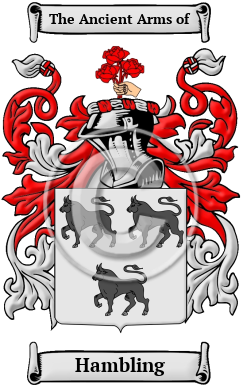
| ![Show Contents]() Hambling History, Family Crest & Coats of Arms Hambling History, Family Crest & Coats of Arms
Etymology of HamblingWhat does the name Hambling mean? The name Hambling arrived in England after the Norman Conquest of 1066. The Hambling family lived in Gloucestershire. Their name, however, is local reference of Old French derivation. It is stems from the Old French root hamel, indicating that the original bearer of the name once worked at an outlying farm which was dependent upon a main village. Several areas in Normandy are called Hamelin. Early Origins of the Hambling familyThe surname Hambling was first found in the Domesday Book of 1086 where "three of this name are entered as under-tenants: Hamelin homo Hugonis filii Baldrici in Lincolnshire; Hamelin holding of Roger de Montgomery in Sussex, and also mentioned in Devonshire; and Hamelin of Cornwall. 'Whether Hamelin of Devonshire and Hamelin of Cornwall were the same person, does not appear. In the latter county Hamelin held twenty-two manors under the Earl of Mortaine. He is supposed to have been the ancestor of the Trelawny family, and to have resided at Treloen, one of the manors described in the Survey as his property." 1 Early History of the Hambling familyThis web page shows only a small excerpt of our Hambling research. Another 91 words (6 lines of text) covering the years 1105, 1129, 1148, 1202, 1275, 1533, 1534 and 1539 are included under the topic Early Hambling History in all our PDF Extended History products and printed products wherever possible. Hambling Spelling VariationsAnglo-Norman names tend to be marked by an enormous number of spelling variations. This is largely due to the fact that Old and Middle English lacked any spelling rules when Norman French was introduced in the 11th century. The languages of the English courts at that time were French and Latin. These various languages mixed quite freely in the evolving social milieu. The final element of this mix is that medieval scribes spelled words according to their sounds rather than any definite rules, so a name was often spelled in as many different ways as the number of documents it appeared in. The name was spelled Hamelin, Hamelyn, Hamelen, Hamelyng, Hamelyne and others. Early Notables of the Hambling familyAnother 35 words (2 lines of text) are included under the topic Early Hambling Notables in all our PDF Extended History products and printed products wherever possible. Migration of the Hambling family to IrelandSome of the Hambling family moved to Ireland, but this topic is not covered in this excerpt.
Another 31 words (2 lines of text) about their life in Ireland is included in all our PDF Extended History products and printed products wherever possible.
| Hambling migration to New Zealand | + |
Emigration to New Zealand followed in the footsteps of the European explorers, such as Captain Cook (1769-70): first came sealers, whalers, missionaries, and traders. By 1838, the British New Zealand Company had begun buying land from the Maori tribes, and selling it to settlers, and, after the Treaty of Waitangi in 1840, many British families set out on the arduous six month journey from Britain to Aotearoa to start a new life. Early immigrants include: Hambling Settlers in New Zealand in the 19th Century- Mr. Chas. Hambling, aged 37, British labourer who arrived in Napier, Hawke's Bay, New Zealand aboard the ship "Winchester" in July 1874
- Mrs. Ann Hambling, aged 35, British settler who arrived in Napier, Hawke's Bay, New Zealand aboard the ship "Winchester" in July 1874
- Miss Ann Hambling, aged 15, British settler who arrived in Napier, Hawke's Bay, New Zealand aboard the ship "Winchester" in July 1874
- Levi Hambling, aged 14, British settler who arrived in Napier, Hawke's Bay, New Zealand aboard the ship "Winchester" in July 1874
- Miss Emma Hambling, aged 12, British settler who arrived in Napier, Hawke's Bay, New Zealand aboard the ship "Winchester" in July 1874
- ... (More are available in all our PDF Extended History products and printed products wherever possible.)
- Cleveland, Dutchess of The Battle Abbey Roll with some Account of the Norman Lineages. London: John Murray, Abermarle Street, 1889. Print. Volume 2 of 3
 |