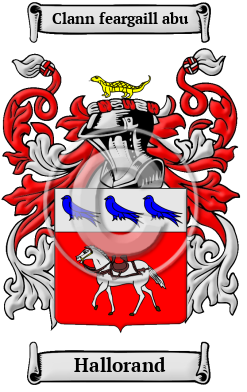
| ![Show Contents]() Hallorand History, Family Crest & Coats of Arms Hallorand History, Family Crest & Coats of Arms
- Origins Available:
Ireland
Etymology of HallorandWhat does the name Hallorand mean? The name Hallorand originally appeared in Gaelic as Ó hAllmhurain, which is derived from the word allmhurach, which means pirate. 1 The main branch of the family claim descent through the O'Connors (Kings of Connaught) and as such from the Heremon Kings of Ireland. (O'Hart) Early Origins of the Hallorand familyThe surname Hallorand was first found in counties of Clare and Galway (Irish: Gaillimh) part of the province of Connacht, located on the west coast of the Island, where they held a family seat from very ancient times. The Holleran variant is typical to Counties Galway and Mayo. 2 "This family were, as the name implies, 'importers' of Wine; and were lords of Clan Fergail, a district in which Galway town is situate; and had their castle at Barns, close to the sea-side, about three miles west of Galway. The MS. Vol. H. 2.17, in the Library of Trinity College, Dublin, states that 'O'Halloran is the chief of twenty-four townlands on Clan Fergail; and of theses are the O'Antuiles and O'Fergus of Roscam.' That statement refers to the twelve century. These twenty-four townlands of Clan Fergail lay east of the river Gallimh (or 'Galway.') In the 13th century the O'Hallorans were dispossessed of their ancient inheritance of Clan Fergail by the De Burgos [(Burke)] invaders. The O'Hallorans and the O'Flahertys, [moved] to Iar (or West) Connaught, where they built the castle of O'Hery in Gnomore; and according to tradition, the castle or Rinville in Northern Connenara. According to the Chronicles of the Wars of Thomond, at A.D. 1309, there was another family of the O'Hallorans in Thomond, descended from the stock of the O'Briens and other Dalcassians in Munster." (O'Hart) Early History of the Hallorand familyThis web page shows only a small excerpt of our Hallorand research. Another 69 words (5 lines of text) are included under the topic Early Hallorand History in all our PDF Extended History products and printed products wherever possible. Hallorand Spelling VariationsIreland in the Middle Ages was inhabited by very few literate people. Therefore, the proper spelling of names was decided by a very select few. The surviving records for the time demonstrate that these scribes were often not consistent in their efforts for there are many spelling variations of certain common names. Some of the variations for the name Hallorand include Halloran, O'Halloran, Haloran and others. Early Notables of the Hallorand familyMore information is included under the topic Early Hallorand Notables in all our PDF Extended History products and printed products wherever possible. Migration of the Hallorand familyDuring the middle of the 19th century, Irish families often experienced extreme poverty and racial discrimination in their own homeland under English rule. Record numbers died of disease and starvation, and many others, deciding against such a fate, boarded ships bound for North America. The largest influx of Irish settlers occurred with Great Potato Famine of the late 1840s. Unfortunately, many of those Irish that arrived in Canada or the United States still experienced economic and racial discrimination. Although often maligned, these Irish people were essential to the rapid development of these countries because they provided the cheap labor required for the many canals, roads, railways, and other projects required for strong national infrastructures. Eventually the Irish went on to make contributions in the less backbreaking and more intellectual arenas of commerce, education, and the arts. Research early immigration and passenger lists revealed many early immigrants bearing the name Hallorand: Biddy, Ellen, Lawrence, Martin, Mathew and Michael Halloran all arrived in Canada in 1847; William O'Halloran arrived in Quebec in 1825; John, James, and Michael O'.
The motto was originally a war cry or slogan. Mottoes first began to be shown with arms in the 14th and 15th centuries, but were not in general use until the 17th century. Thus the oldest coats of arms generally do not include a motto. Mottoes seldom form part of the grant of arms: Under most heraldic authorities, a motto is an optional component of the coat of arms, and can be added to or changed at will; many families have chosen not to display a motto.
Motto: Clann feargaill abu
- MacLysaght, Edward, Irish Families Their Names, Arms and Origins 4th Edition. Dublin: Irish Academic, 1982. Print. (ISBN 0-7165-2364-7)
- MacLysaght, Edward, The Surnames of Ireland. Ireland: Irish Academic Press, sixth edition, 1985. Print. (ISBN 0-7165-2366-3)
 |