| ![Show Contents]() Halivier History, Family Crest & Coats of Arms Halivier History, Family Crest & Coats of Arms
Etymology of HalivierWhat does the name Halivier mean? Halivier is an ancient Scottish name that was first used by the Strathclyde-Briton people of the Scottish/English Borderlands. It is a name for someone who lived in Roxburgh. While most of the name likely derive from the Old French Oivier, it is supposed that some of the Scottish instances of this name derive from the Old Norse name Oleifr. Early Origins of the Halivier familyThe surname Halivier was first found in Roxburghshire, where the first on record in this shire was Walter Olifer who was a Justiciar (Judge) of the district, who witnessed a gift of William the Lion to the serf Gillemachoi de Conglud with his children and all his descendants to the bishop of Glasgow c. 1180. Olyver, son of Kyluert, was one of the followers of the earl of March at end of twelfth century. 1 Despite the fact that the lion's hare of the family do originate in Scotland and into the English borders, there are significant early English records. "Its principal homes are as follows: in the north, in Northumberland and Durham, whence it extends into the Scottish border counties; in the west, in Herefordshire; in the east, in Lincolnshire; in the south - west (including the contracted form of Olver), in Cornwall; and in the south - east, in Kent and Sussex. " 2 And we would be remiss if we did not mention the earliest entry of the family in the Domesday Book of 1086 as a personal name. Later, the Hundredorum Rolls of 1273 list the name as both a personal name and a surname: Oliver Crane in Huntingdonshire, 1273; and Peter filius Oliver in Oxfordshire. 3 Early History of the Halivier familyThis web page shows only a small excerpt of our Halivier research. Another 103 words (7 lines of text) covering the years 1250, 1266, 1330, 1436, 1541, 1542, 1546, 1557 and 1890 are included under the topic Early Halivier History in all our PDF Extended History products and printed products wherever possible. Halivier Spelling VariationsPrior to the first dictionaries, scribes spelled words according to sound. This, and the fact that Scottish names were repeatedly translated from Gaelic to English and back, contributed to the enormous number of spelling variations in Scottish names. Halivier has been spelled Oliver, Olivier, Ollivier, Olliver and others. Early Notables of the Halivier familyJohn Oliuer, prepositus of Berwick, who witnessed a gift of land to the Hospital of Soltre, c. 1250-1266; William Holifarth or Holyfarth held land in Perth, c. 1330; Thomas Olyver de Swyne who witnessed a declaration dated 1436; Wille Olipher in Petarno, a follower of...
Another 45 words (3 lines of text) are included under the topic Early Halivier Notables in all our PDF Extended History products and printed products wherever possible. Migration of the Halivier family to IrelandSome of the Halivier family moved to Ireland, but this topic is not covered in this excerpt.
Another 90 words (6 lines of text) about their life in Ireland is included in all our PDF Extended History products and printed products wherever possible. Migration of the Halivier familyIn such difficult times, the difficulties of raising the money to cross the Atlantic to North America did not seem so large compared to the problems of keeping a family together in Scotland. It was a journey well worth the cost, since it was rewarded with land and freedom the Scots could not find at home. The American War of Independence solidified that freedom, and many of those settlers went on to play important parts in the forging of a great nation. Among them: Evan Oliver who settled in Delaware with his wife Jean and seven children in 1682; Mary Oliver settled in Virginia in 1651; Nicholas Oliver settled in Virginia in 1638.
The motto was originally a war cry or slogan. Mottoes first began to be shown with arms in the 14th and 15th centuries, but were not in general use until the 17th century. Thus the oldest coats of arms generally do not include a motto. Mottoes seldom form part of the grant of arms: Under most heraldic authorities, a motto is an optional component of the coat of arms, and can be added to or changed at will; many families have chosen not to display a motto.
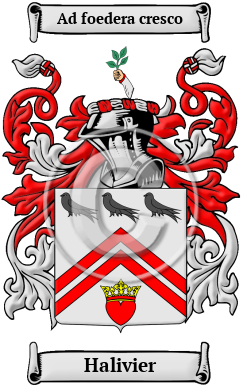
Motto: Ad foedera cresco
Motto Translation: I gain by treaty
- Black, George F., The Surnames of Scotland Their Origin, Meaning and History. New York: New York Public Library, 1946. Print. (ISBN 0-87104-172-3)
- Guppy, Henry Brougham, Homes of Family Names in Great Britain. 1890. Print.
- Bardsley, C.W, A Dictionary of English and Welsh Surnames: With Special American Instances. Wiltshire: Heraldry Today, 1901. Print. (ISBN 0-900455-44-6)
 |