| ![Show Contents]() Hüm History, Family Crest & Coats of Arms Hüm History, Family Crest & Coats of Arms
Early Origins of the Hüm familyThe surname Hüm was first found in the East Anglian county of Norfolk where Robert del Houme was listed in the Curia Regis Rolls of 1222. In Worcester, Alan de Hone was recorded in the Subsidy Rolls for 1275, and a few years later, Henry and William Home were found in the Hundredorum Rolls for Oxfordshire in 1279. Walter of the home and John atte Home were both listed in the Subsidy Rolls for Worcester in 1327. 1 The Hundredorum Rolls also included Goscelin de Holme, Suffolk and John in le Holmp (sic), Cambridgeshire. 2 Further north, in the historic county of Yorkshire, the Yorkshire Poll Tax Rolls of 1379 listed Thomas del Holme; Adam del Holme; and Johannes del Holme. 2 "A holme is defined by Halliwell as 'flat land; a small island; a deposit of soil at the confluence of two waters. Flat grounds near water are called holms.' 3 Early History of the Hüm familyThis web page shows only a small excerpt of our Hüm research. Another 111 words (8 lines of text) covering the years 1296, 1490, 1506, 1516, 1549, 1566, 1575, 1615, 1619, 1633, 1666, 1671, 1674, 1687, 1698, 1706, 1797 and 1890 are included under the topic Early Hüm History in all our PDF Extended History products and printed products wherever possible. Hüm Spelling VariationsThe name, Hüm, occurred in many references, and from time to time, it was spelt Home, Hume, Humes and others. Early Notables of the Hüm familyAlexander Home, 1st Lord Home (d. 1490); Alexander Home, 2nd Lord Home (d. 1506); Alexander Home, 3rd Lord Home (d. 1516); George Home, 4th Lord Home (d. 1549); Alexander Home, 5th Lord Home (d. 1575); Alexander Home, 1st Earl of Home (c. 1566-1619); James Home, 2nd Earl of Home (d. 1633); James Home, 3rd Earl of Home (c. 1615-1666); Alexander...
Another 59 words (4 lines of text) are included under the topic Early Hüm Notables in all our PDF Extended History products and printed products wherever possible. Migration of the Hüm family to IrelandSome of the Hüm family moved to Ireland, but this topic is not covered in this excerpt.
Another 89 words (6 lines of text) about their life in Ireland is included in all our PDF Extended History products and printed products wherever possible.
| Hüm migration to the United States | + |
The New World beckoned settlers from the Scottish-English borders. They sailed aboard the armada of sailing ships known as the "White Sails" which plied the stormy Atlantic. Some called them, less romantically, the "coffin ships." Among the early settlers bearing the Hüm surname who came to North America were:
Hüm Settlers in United States in the 18th Century- Anne Hum, who arrived in Virginia in 1706 4
| Hüm migration to Australia | + |
Hüm Settlers in Australia in the 19th Century- Mr. Henry Hum, English convict who was convicted in Essex, England for 7 years, transported aboard the "Captain Cook" on 2nd May 1833, arriving in New South Wales, Australia 5
- Mr. William Hum, English convict who was convicted in Kent, England for 7 years, transported aboard the "Aurora" on 18th June 1835, arriving in Tasmania (Van Diemen's Land) 6
| Hüm migration to New Zealand | + |
Emigration to New Zealand followed in the footsteps of the European explorers, such as Captain Cook (1769-70): first came sealers, whalers, missionaries, and traders. By 1838, the British New Zealand Company had begun buying land from the Maori tribes, and selling it to settlers, and, after the Treaty of Waitangi in 1840, many British families set out on the arduous six month journey from Britain to Aotearoa to start a new life. Early immigrants include: Hüm Settlers in New Zealand in the 19th Century- Mr. George Hum, (b. 1825), aged 30, British labourer travelling from London aboard the ship "Grasmere" arriving in Lyttelton, Christchurch, South Island, New Zealand on 4th May 1855 7
- Mrs. Margaret Hum, (b. 1825), aged 30, British settler travelling from London aboard the ship "Grasmere" arriving in Lyttelton, Christchurch, South Island, New Zealand on 4th May 1855 7
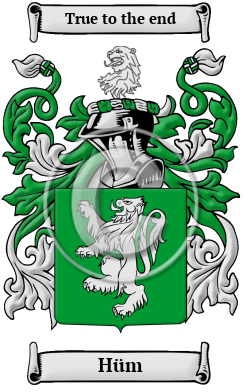
The motto was originally a war cry or slogan. Mottoes first began to be shown with arms in the 14th and 15th centuries, but were not in general use until the 17th century. Thus the oldest coats of arms generally do not include a motto. Mottoes seldom form part of the grant of arms: Under most heraldic authorities, a motto is an optional component of the coat of arms, and can be added to or changed at will; many families have chosen not to display a motto.
Motto: True to the end
- Reaney, P.H and R.M. Wilson, A Dictionary of English Surnames. London: Routledge, 1991. Print. (ISBN 0-415-05737-X)
- Bardsley, C.W, A Dictionary of English and Welsh Surnames: With Special American Instances. Wiltshire: Heraldry Today, 1901. Print. (ISBN 0-900455-44-6)
- Lower, Mark Anthony, Patronymica Britannica, A Dictionary of Family Names of the United Kingdom. London: John Russel Smith, 1860. Print.
- Filby, P. William, Meyer, Mary K., Passenger and immigration lists index : a guide to published arrival records of about 500,000 passengers who came to the United States and Canada in the seventeenth, eighteenth, and nineteenth centuries. 1982-1985 Cumulated Supplements in Four Volumes Detroit, Mich. : Gale Research Co., 1985, Print (ISBN 0-8103-1795-8)
- Convict Records Voyages to Australia (Retrieved 17th December 2020). Retrieved from https://convictrecords.com.au/ships/captain-cook
- Convict Records Voyages to Australia (Retrieved 20th August 2020). Retrieved from https://convictrecords.com.au/ships/aurora
- New Zealand Yesteryears Passenger Lists 1800 to 1900 (Retrieved 17th October 2018). Retrieved from http://www.yesteryears.co.nz/shipping/passlist.html
 |