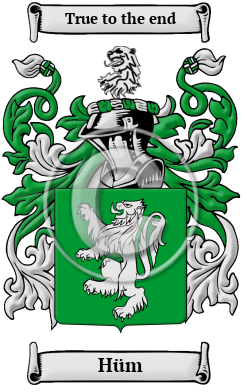
| ![Show Contents]() Hüm History, Family Crest & Coats of Arms Hüm History, Family Crest & Coats of Arms
Etymology of HümWhat does the name Hüm mean? The Hüm family lived in Berwickshire. They held the barony of Home from very early times and possibly predate the Norman Conquest in 1066. The Home family is part of a noble lineage descending from the Earls of Dunbar, and the family of the Earl of Northumberland, the great Gospatrick, a descendent of the Kings of Bernicia. They first appear in the records in 1268, when William of Home appeared on a charter. They next appear (as so many of the prominent Scottish families do) in 1296, when Geffrai de Home of Lanarkshire swore an oath of allegiance (in the Ragman Rolls) to King Edward I of England after that king's brief conquest of Scotland. Early Origins of the Hüm familyThe surname Hüm was first found in Berwickshire an ancient county of Scotland, presently part of the Scottish Borders Council Area, located in the eastern part of the Borders Region of Scotland. They held the barony of Home from very early times, and possibly predate the Norman Conquest in 1066. There were many branches of the Hüm family including the Homes of Cowdenknowes, the Homes of Wedderburn, the Homes of Manderston, the Homes of Renton, the Homes of Kames, and the Homes of Blackadder. Early History of the Hüm familyThis web page shows only a small excerpt of our Hüm research. Another 132 words (9 lines of text) covering the years 1456, 1468, 1506, 1560, 1569, 1604, 1609, 1641, 1645, 1648, 1671, 1696, 1698, 1702, 1724, 1797 and 1890 are included under the topic Early Hüm History in all our PDF Extended History products and printed products wherever possible. Hüm Spelling VariationsOver the years, Hüm has been written It appears under these variations because medieval scribes spelled names according to sound rather than by any over-arching set of rules. Humes, Hum, Humme, Humm, Homes and others. Early Notables of the Hüm family- Sir Alexander Home or Hume (d. 1456), of Home, Warden of the Marches, the eldest son of Sir Alexander Home of Dunglass 1
- Alexander Hume (c.1560-c.1609), Scottish poet
- Tobias Hume (c.1569-1645), a Scottish composer, viol player and soldier
- George Home, created Baron Hume of Berwick in 1604, Lord Treasurer of Scotland
- Sir Patrick Hume (d. 1648), 1st Baronet Hume of Polwarth
- Sir Patrick Hume (1641-1724) of Polwarth, Lord Chancellor of Scotland (1696-1702), created Lord Polwarth, of Polwarth, Redbraes and Greenlaw
Migration of the Hüm family to IrelandSome of the Hüm family moved to Ireland, but this topic is not covered in this excerpt.
Another 89 words (6 lines of text) about their life in Ireland is included in all our PDF Extended History products and printed products wherever possible.
| Hüm migration to the United States | + |
When these Boernician-Scottish settlers arrived in North America they brought little with them and often had restart their lives from scratch. Through time, much of their heritage was lost, and it is only this century through Clan societies and highland games that many have recovered their national heritage. Research into various historical records has revealed some of first members of the Hüm family to immigrate North America:
Hüm Settlers in United States in the 18th Century- Anne Hum, who arrived in Virginia in 1706 2
| Hüm migration to Australia | + |
Hüm Settlers in Australia in the 19th Century- Mr. Henry Hum, English convict who was convicted in Essex, England for 7 years, transported aboard the "Captain Cook" on 2nd May 1833, arriving in New South Wales, Australia 3
- Mr. William Hum, English convict who was convicted in Kent, England for 7 years, transported aboard the "Aurora" on 18th June 1835, arriving in Tasmania (Van Diemen's Land) 4
| Hüm migration to New Zealand | + |
Emigration to New Zealand followed in the footsteps of the European explorers, such as Captain Cook (1769-70): first came sealers, whalers, missionaries, and traders. By 1838, the British New Zealand Company had begun buying land from the Maori tribes, and selling it to settlers, and, after the Treaty of Waitangi in 1840, many British families set out on the arduous six month journey from Britain to Aotearoa to start a new life. Early immigrants include: Hüm Settlers in New Zealand in the 19th Century- Mr. George Hum, (b. 1825), aged 30, British labourer travelling from London aboard the ship "Grasmere" arriving in Lyttelton, Christchurch, South Island, New Zealand on 4th May 1855 5
- Mrs. Margaret Hum, (b. 1825), aged 30, British settler travelling from London aboard the ship "Grasmere" arriving in Lyttelton, Christchurch, South Island, New Zealand on 4th May 1855 5
The motto was originally a war cry or slogan. Mottoes first began to be shown with arms in the 14th and 15th centuries, but were not in general use until the 17th century. Thus the oldest coats of arms generally do not include a motto. Mottoes seldom form part of the grant of arms: Under most heraldic authorities, a motto is an optional component of the coat of arms, and can be added to or changed at will; many families have chosen not to display a motto.
Motto: True to the end
- Smith, George (ed), Dictionary of National Biography. London: Smith, Elder & Co., 1885-1900. Print
- Filby, P. William, Meyer, Mary K., Passenger and immigration lists index : a guide to published arrival records of about 500,000 passengers who came to the United States and Canada in the seventeenth, eighteenth, and nineteenth centuries. 1982-1985 Cumulated Supplements in Four Volumes Detroit, Mich. : Gale Research Co., 1985, Print (ISBN 0-8103-1795-8)
- Convict Records Voyages to Australia (Retrieved 17th December 2020). Retrieved from https://convictrecords.com.au/ships/captain-cook
- Convict Records Voyages to Australia (Retrieved 20th August 2020). Retrieved from https://convictrecords.com.au/ships/aurora
- New Zealand Yesteryears Passenger Lists 1800 to 1900 (Retrieved 17th October 2018). Retrieved from http://www.yesteryears.co.nz/shipping/passlist.html
 |