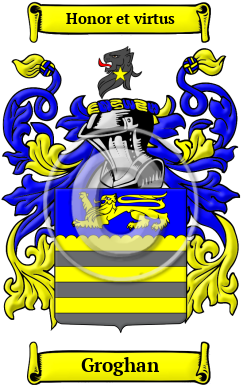
All Irish surnames have a unique and often romantic meaning. The name Groghan originally appeared in Gaelic as "O Grugain," which is derived from either "gruag," which means "hair," and "grug," which means "fierceness."
Loading...
Early Origins of the Groghan family
The surname Groghan was first found in County Roscommon (Irish: Ros Comáin) located in central Ireland in the province of Connacht, where they held a family seat from very ancient times.
Early History of the Groghan family
This web page shows only a small excerpt of our Groghan research. Another 89 words (6 lines of text) covering the year 1172 is included under the topic Early Groghan History in all our PDF Extended History products and printed products wherever possible.
Groghan Spelling Variations
Because early scribes and church officials often spelled names as they sounded, a person could have many various spellings of his name.Many different spelling variations of the surname Groghan were found in the archives researched. These included Grogan, O'Grogan, Grogen, Groogen, Grugen, Groggan, O'Groogan and many more.
Early Notables of the Groghan family
More information is included under the topic Early Groghan Notables in all our PDF Extended History products and printed products wherever possible.
Loading...
Loading...
Loading...
Loading...
Migration of the Groghan family
A massive wave of Irish immigrants hit North America during the 19th century. Although many early Irish immigrants made a carefully planned decision to leave left Ireland for the promise of free land, by the 1840s immigrants were fleeing a famine stricken land in desperation. The condition of Ireland during the Great Potato Famine of the late 1840s can be attributed to a rapidly expanding population and English imperial policies. Those Irish families that arrived in North America were essential to its rapid social, industrial, and economic development. Passenger and immigration lists have revealed a number of early Irish immigrants bearing the name Groghan: Alexander Grogan settled in Virginia in 1652; Charles, James, Jeremiah, John, Michael, Nathaniel Grogan, all arrived in Philadelphia between 1840 and 1860.
The motto was originally a war cry or slogan. Mottoes first began to be shown with arms in the 14th and 15th centuries, but were not in general use until the 17th century. Thus the oldest coats of arms generally do not include a motto. Mottoes seldom form part of the grant of arms: Under most heraldic authorities, a motto is an optional component of the coat of arms, and can be added to or changed at will; many families have chosen not to display a motto.
Motto: Honor et virtus Motto Translation: Honour and virtue.
Remove Item
WARNING!
Removing this item from your shopping cart will remove your associated sale items.
Are you sure you want to delete this item from your shopping cart?
HouseofNames E-Newsletter Sign Up
On Demand Gifts | Digital Products Available 24/7
A Gift for Everyone on your List is a Click Away - Shop Now