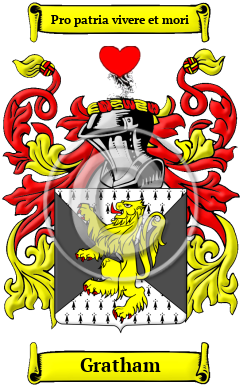
The Gratham surname was Mag Reachtain in Irish Gaelic.
Loading...
Early Origins of the Gratham family
The surname Gratham was first found in Tipperary (Irish: Thiobraid Árann), established in the 13th century in South-central Ireland, in the province of Munster, where they held a family seat from very early times.
Early History of the Gratham family
This web page shows only a small excerpt of our Gratham research. Another 149 words (11 lines of text) covering the years 1300, 1500 and 1700 are included under the topic Early Gratham History in all our PDF Extended History products and printed products wherever possible.
Gratham Spelling Variations
Names from the Middle Ages demonstrate many spelling variations. This is because the recording scribe or church official often decided as to how a person's name was spelt and in what language. Research into the name Gratham revealed many variations, including Gratton, Grattan, MacGrattan and others.
Early Notables of the Gratham family
More information is included under the topic Early Gratham Notables in all our PDF Extended History products and printed products wherever possible.
Loading...
Loading...
Loading...
Loading...
Migration of the Gratham family
Thousands of Irish families left for North American shores in the 19th century. These people were searching for a life unencumbered with poverty, hunger, and racial discrimination. Many arrived to eventually find such conditions, but many others simply did not arrive: victims of the diseased, overcrowded ships in which they traveled to the New World. Those who lived to see North American shores were instrumental in the development of the growing nations of Canada and the United States. A thorough examination of passenger and immigration lists has disclosed evidence of many early immigrants of the name Gratham: John Gratton, who settled in New York in 1820 and Edward Gratton landed in Philadelphia in 1862; Mary Gratton settled in Boston Massachusetts in 1848; Edward Grattan settled in Philadelphia, Pennsylvania in 1862..
The motto was originally a war cry or slogan. Mottoes first began to be shown with arms in the 14th and 15th centuries, but were not in general use until the 17th century. Thus the oldest coats of arms generally do not include a motto. Mottoes seldom form part of the grant of arms: Under most heraldic authorities, a motto is an optional component of the coat of arms, and can be added to or changed at will; many families have chosen not to display a motto.
Motto: Pro patria vivere et mori Motto Translation: For my country, I live and die
Remove Item
WARNING!
Removing this item from your shopping cart will remove your associated sale items.
Are you sure you want to delete this item from your shopping cart?
HouseofNames E-Newsletter Sign Up
On Demand Gifts | Digital Products Available 24/7
A Gift for Everyone on your List is a Click Away - Shop Now