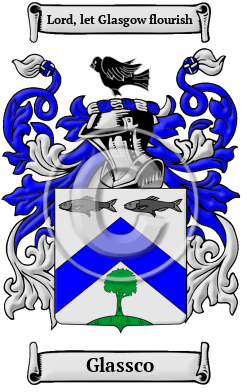
| ![Show Contents]() Glassco History, Family Crest & Coats of Arms Glassco History, Family Crest & Coats of Arms
- Origins Available:
Scotland
Ireland
Etymology of GlasscoWhat does the name Glassco mean? The age-old Scottish surname Glassco was first used by the Strathclyde-Briton people. The Glassco family lived in the city of Glasgow on the river Clyde in the county of Renfrew (first recorded in 1116 as Glasgu), or from either of two minor places with the same name in Aberdeenshire. The origins of the place name are uncertain, it may come from the Welsh glas, or "gray," and cau, meaning "hollows." 1 2 Early Origins of the Glassco familyThe surname Glassco was first found in Renfrewshire (Gaelic: Siorrachd Rinn Friù), a historic county of Scotland, today encompassing the Council Areas of Renfrew, East Renfrewshire, and Iverclyde, in the Strathclyde region of southwestern Scotland. 3 One of the first records of the family was that of John de Glasgu, who was chaplain of Gamelin, bishop of St. Andrews in 1258. Later, Andrew de Glasgow was an escheator in 1289, and John of Glasgow appears as a monk of Holyrood in 1299. "Payment was made to John de Glasgu in 1343 for the table of the king's servants, Alan Glasgw was murdered in 1494, and Robert Glasgow was a witness in the burgh in 1554." 4 Early History of the Glassco familyThis web page shows only a small excerpt of our Glassco research. Another 85 words (6 lines of text) covering the years 1258, 1259, 1287, 1289, 1299, 1340, 1343, 1419, 1568, 1614, 1629, 1653, 1690, 1693, 1721, 1761, 1764, 1792, 1873 and 1890 are included under the topic Early Glassco History in all our PDF Extended History products and printed products wherever possible. Glassco Spelling VariationsIn Medieval times, spelling and translation were not nearly so highly developed as today. They were generally carried out according to the sound and intuition of the bearer. For that reason spelling variations are extremely common among early Scottish names. Glassco has been spelled Glassgow, Glasgow, Glassgaw and others. Early Notables of the Glassco familyJohn de Glasgu (fl. 1259), chaplain to Bishop Gamelin. John of Glasgow (fl. 1287-1289), was a Scottish monk of Holyrood Abbey. Andrew de Glasgow (fl. 1289), was a burgh official overseeing escheats for the Exchequer. John de Glasgu (fl. 1343), royal servant compensated for services to the king's table. Master John de Glasgow (c. 1340-before 1419), was Vicar of St. Mary's and Canon of Moray. John Glasgow M.A. (fl...
Another 68 words (5 lines of text) are included under the topic Early Glassco Notables in all our PDF Extended History products and printed products wherever possible. Migration of the Glassco family to IrelandSome of the Glassco family moved to Ireland, but this topic is not covered in this excerpt.
Another 111 words (8 lines of text) about their life in Ireland is included in all our PDF Extended History products and printed products wherever possible. Migration of the Glassco familyUnrest, poverty, and persecution caused thousands to look for opportunity and freedom in the North American colonies. The crossing was long, overcrowded, and unsanitary, though, and came only at great expense. Many Strathclyde families settled on the east coast of North America in communities that would form the backbone of what would become the great nations of the United States and Canada. The American War of Independence caused those who remained loyal to England to move north to Canada as United Empire Loyalists. In the 20th century, Strathclyde and other Scottish families across North America began to recover their collective heritage through highland games and Clan societies. Among them: Edward Glascow who settled in New York in 1822; Elizabeth, Hannah, Samuel, and William Glascow settled in New England in 1760.
| Contemporary Notables of the name Glassco (post 1700) | + |
- Kurt G. Glassco, American Democratic Party politician, Candidate for U.S. Representative from Oklahoma 1st District, 1988, 1990 5
The motto was originally a war cry or slogan. Mottoes first began to be shown with arms in the 14th and 15th centuries, but were not in general use until the 17th century. Thus the oldest coats of arms generally do not include a motto. Mottoes seldom form part of the grant of arms: Under most heraldic authorities, a motto is an optional component of the coat of arms, and can be added to or changed at will; many families have chosen not to display a motto.
Motto: Lord, let Glasgow flourish
- Smith, Eldson Coles, New Dictionary of American Family Names New York: Harper & Row, 1956. Print
- Harrison, Henry, Surnames of the United Kingdom: A Concise Etymological Dictionary Baltimore: Geneological Publishing Company, 2013. Print
- Sims, Clifford Stanley The Origin and Signification of Scottish Surnames. 1862. Print.
- Black, George F., The Surnames of Scotland Their Origin, Meaning and History. New York: New York Public Library, 1946. Print. (ISBN 0-87104-172-3)
- The Political Graveyard: Alphabetical Name Index. (Retrieved 2015, October 26) . Retrieved from http://politicalgraveyard.com/alpha/index.html
 |