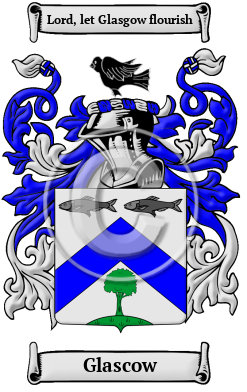
| ![Show Contents]() Glascow History, Family Crest & Coats of Arms Glascow History, Family Crest & Coats of Arms
- Origins Available:
Scotland
Ireland
Etymology of GlascowWhat does the name Glascow mean? The ancient Scottish name Glascow was first used by the Strathclyde-Briton people of the Scottish/English Borderlands. The original bearer of the name lived in the city of Glasgow on the river Clyde in the county of Renfrew (first recorded in 1116 as Glasgu), or from either of two minor places with the same name in Aberdeenshire. The origins of the place name are uncertain, it may come from the Welsh glas, or "gray," and cau, meaning "hollows." 1 2 Early Origins of the Glascow familyThe surname Glascow was first found in Renfrewshire (Gaelic: Siorrachd Rinn Friù), a historic county of Scotland, today encompassing the Council Areas of Renfrew, East Renfrewshire, and Iverclyde, in the Strathclyde region of southwestern Scotland. 3 One of the first records of the family was that of John de Glasgu, who was chaplain of Gamelin, bishop of St. Andrews in 1258. Later, Andrew de Glasgow was an escheator in 1289, and John of Glasgow appears as a monk of Holyrood in 1299. "Payment was made to John de Glasgu in 1343 for the table of the king's servants, Alan Glasgw was murdered in 1494, and Robert Glasgow was a witness in the burgh in 1554." 4 Early History of the Glascow familyThis web page shows only a small excerpt of our Glascow research. Another 85 words (6 lines of text) covering the years 1258, 1259, 1287, 1289, 1299, 1340, 1343, 1419, 1568, 1614, 1629, 1653, 1690, 1693, 1721, 1761, 1764, 1792, 1873 and 1890 are included under the topic Early Glascow History in all our PDF Extended History products and printed products wherever possible. Glascow Spelling VariationsThe many spelling variations in Medieval Scottish names result from the fact that scribes in that era spelled words according to sound. Translation too, was an undeveloped science, and many names were altered into complete obscurity. Over the years Glascow has been spelled Glassgow, Glasgow, Glassgaw and others. Early Notables of the Glascow familyJohn de Glasgu (fl. 1259), chaplain to Bishop Gamelin. John of Glasgow (fl. 1287-1289), was a Scottish monk of Holyrood Abbey. Andrew de Glasgow (fl. 1289), was a burgh official overseeing escheats for the Exchequer. John de Glasgu (fl. 1343), royal servant compensated for services to the king's table. Master John de Glasgow (c. 1340-before 1419), was Vicar of St. Mary's and Canon of Moray. John Glasgow M.A. (fl...
Another 68 words (5 lines of text) are included under the topic Early Glascow Notables in all our PDF Extended History products and printed products wherever possible. Migration of the Glascow family to IrelandSome of the Glascow family moved to Ireland, but this topic is not covered in this excerpt.
Another 111 words (8 lines of text) about their life in Ireland is included in all our PDF Extended History products and printed products wherever possible.
| Glascow migration to the United States | + |
To escape the uncertainties and discrimination faced in Scotland, many decided to head out for North America. Once they arrived, many Scots fought with relish in the American War of Independence; some went north to Canada as United Empire Loyalists. Many ancestors of these Scots have recovered their lost national heritage in the 20th century through Clan organizations and Scottish historical societies. Among the settlers to North America were:
Glascow Settlers in United States in the 18th Century- Elizabeth, Hannah, Samuel, and William Glascow, who settled in New England in 1760
- Samuel Glascow, who landed in America in 1760-1763 5
Glascow Settlers in United States in the 19th Century- Edward Glascow who settled in New York in 1822
The motto was originally a war cry or slogan. Mottoes first began to be shown with arms in the 14th and 15th centuries, but were not in general use until the 17th century. Thus the oldest coats of arms generally do not include a motto. Mottoes seldom form part of the grant of arms: Under most heraldic authorities, a motto is an optional component of the coat of arms, and can be added to or changed at will; many families have chosen not to display a motto.
Motto: Lord, let Glasgow flourish
- Smith, Eldson Coles, New Dictionary of American Family Names New York: Harper & Row, 1956. Print
- Harrison, Henry, Surnames of the United Kingdom: A Concise Etymological Dictionary Baltimore: Geneological Publishing Company, 2013. Print
- Sims, Clifford Stanley The Origin and Signification of Scottish Surnames. 1862. Print.
- Black, George F., The Surnames of Scotland Their Origin, Meaning and History. New York: New York Public Library, 1946. Print. (ISBN 0-87104-172-3)
- Filby, P. William, Meyer, Mary K., Passenger and immigration lists index : a guide to published arrival records of about 500,000 passengers who came to the United States and Canada in the seventeenth, eighteenth, and nineteenth centuries. 1982-1985 Cumulated Supplements in Four Volumes Detroit, Mich. : Gale Research Co., 1985, Print (ISBN 0-8103-1795-8)
 |