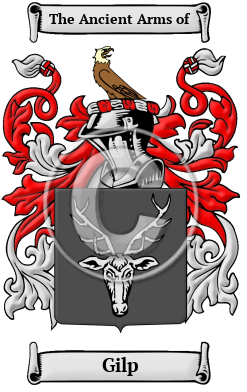
| ![Show Contents]() Gilp History, Family Crest & Coats of Arms Gilp History, Family Crest & Coats of Arms
- Origins Available:
Scotland
Ireland
Etymology of GilpWhat does the name Gilp mean? The root of the ancient Dalriadan-Scottish name Gilp is the personal name Philip, which is originally derived from the Greek personal name Philippos, which means horse-lover. The Gaelic form of the surname is Mac Fhilib, meaning son of Philip. The f is aspirated in the genitive case, causing it to disappear. 1 Early Origins of the Gilp familyThe surname Gilp was first found in Argyllshire (Gaelic erra Ghaidheal), the region of western Scotland corresponding roughly with the ancient Kingdom of Dál Riata, in the Strathclyde region of Scotland, now part of the Council Area of Argyll and Bute, where they held a family seat at Brae Lochaber from ancient times being descended from an ancient chieftain of the MacDonnells of Keppoch who were, in turn, descended from the Lords of the Isles. It has been suggested that the MacKillops or MacGilps may be the sons of Ilpin or Gilpin, in Iam Lom's "Soiidh do'n Ghreumach." "Some of this name are said to have been standard-bearers to the Campbells of Dunstaffnage, others are included as septs of Macdonald of Glencoe and of Macdonells of Keppoch, and Mackillop also occurs as a surname in Arran. Finlaius Macpilibh, priest of the diocese of Argyll, is in record in 1433, and in 1437 John, son of Fynlaius Prioris Macphilib, appears as perpetual vicar of Kilcalmonell." 1 The MacPhillip or MacPhillips variant reappears later in history as the first record of the branch was found as "Philip, a son of Fingonius, prior of Iona, who was commemorated on a tombstone in Cladh Reg, Kirkapoll, Tiree, 1495. " 1 Early History of the Gilp familyThis web page shows only a small excerpt of our Gilp research. Another 124 words (9 lines of text) covering the years 1433, 1437, 1526, 1532, 1547 and 1659 are included under the topic Early Gilp History in all our PDF Extended History products and printed products wherever possible. Gilp Spelling VariationsThe translation of Gaelic names in the Middle Ages was not a task undertaken with great care. Records from that era show an enormous number of spelling variations, even in names referring to the same person. Over the years Gilp has appeared as MacKillop, McKillop, MacGilp, McGilp, MacKillip, McKillip, MacGillip, McGillip, MacKillup, McKillup, Kellop, Kellops, Killop, Killup, Gilp, Gillip, Killip, Killips, MacFhilib, MacPhilip and many more. Early Notables of the Gilp familyMore information is included under the topic Early Gilp Notables in all our PDF Extended History products and printed products wherever possible. Migration of the Gilp family to IrelandSome of the Gilp family moved to Ireland, but this topic is not covered in this excerpt.
Another 145 words (10 lines of text) about their life in Ireland is included in all our PDF Extended History products and printed products wherever possible. Migration of the Gilp familyMany settled along the east coast of what would become the United States and Canada. As the American War of Independence broke out, those who remained loyal to the crown went north to Canada as United Empire Loyalists. The ancestors of all of these hardy Dalriadan-Scottish settlers began to recover their collective history in the 20th century with the advent of the vibrant culture fostered by highland games and Clan societies in North America. Highland games, Clan societies, and other organizations generated much renewed interest in Scottish heritage in the 20th century. The Gilp were among the earliest of the Scottish settlers as immigration passenger lists have shown: John McKillop arrived in Boston Mass in 1767; Hugh McKillop arrived in Pennsylvania in 1833; Robert McKillup arrived in Pennsylvania in 1839.
- Black, George F., The Surnames of Scotland Their Origin, Meaning and History. New York: New York Public Library, 1946. Print. (ISBN 0-87104-172-3)
 |