| ![Show Contents]() Ghey History, Family Crest & Coats of Arms Ghey History, Family Crest & Coats of Arms
- Origins Available:
Ireland
Etymology of GheyWhat does the name Ghey mean? The surname is one of the native Irish surnames that come from the Irish Gaelic language. The original Gaelic form of the name Ghey is "Mac Eachaidh," from the personal name Eachaidh, which is Anglicized as Aghy. It is cognate with Eochaigh, which is Anglicized as the once-common Christian name Oghy. Early Origins of the Ghey familyThe surname Ghey was first found in the county of Cork (Irish: Corcaigh) the ancient Kingdom of Deis Muin (Desmond), located on the southwest coast of Ireland in the province of Munster, where they held a family seat from ancient times. Early History of the Ghey familyThis web page shows only a small excerpt of our Ghey research. Another 106 words (8 lines of text) are included under the topic Early Ghey History in all our PDF Extended History products and printed products wherever possible. Ghey Spelling VariationsNames from the Middle Ages demonstrate many spelling variations. This is because the recording scribe or church official often decided as to how a person's name was spelt and in what language. Research into the name Ghey revealed many variations, including Caughey, McCaughey, McGaughey, Coffee, Coffey, Coffy, O'Coffey, O'Coffy, Mulcahy, McGahey and many more. Early Notables of the Ghey familyMore information is included under the topic Early Ghey Notables in all our PDF Extended History products and printed products wherever possible. Migration of the Ghey familyTo escape the religious and political discrimination they experienced primarily at the hands of the English, thousands of Irish left their homeland in the 19th century. These migrants typically settled in communities throughout the East Coast of North America, but also joined the wagon trains moving out to the Midwest. Ironically, when the American War of Independence began, many Irish settlers took the side of England, and at the war's conclusion moved north to Canada. These United Empire Loyalists, were granted land along the St. Lawrence River and the Niagara Peninsula. Other Irish immigrants settled in Newfoundland, the Ottawa Valley, New Brunswick and Nova Scotia. The greatest influx of Irish immigrants, however, came to North America during the Great Potato Famine of the late 1840s. Thousands left Ireland at this time for North America and Australia. Many of those numbers, however, did not live through the long sea passage. These Irish settlers to North America were immediately put to work building railroads, coal mines, bridges, and canals. Irish settlers made an inestimable contribution to the building of the New World. Early North American immigration records have revealed a number of people bearing the Irish name Ghey or a variant listed above, including: John Caughey who settled in New York in 1845; James Coffe who settled in Boston in 1754; Bridget Coffee settled in Boston in 1849; John Coffee settled in Virginia in 1637.
The motto was originally a war cry or slogan. Mottoes first began to be shown with arms in the 14th and 15th centuries, but were not in general use until the 17th century. Thus the oldest coats of arms generally do not include a motto. Mottoes seldom form part of the grant of arms: Under most heraldic authorities, a motto is an optional component of the coat of arms, and can be added to or changed at will; many families have chosen not to display a motto.
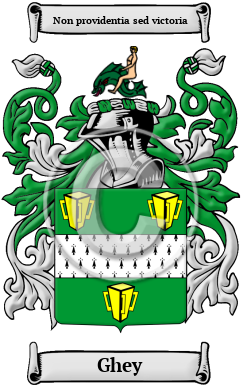
Motto: Non providentia sed victoria
Motto Translation: No victory without foresight
 |