| ![Show Contents]() Gallin History, Family Crest & Coats of Arms Gallin History, Family Crest & Coats of Arms
Etymology of GallinWhat does the name Gallin mean? The origins of the Anglo-Saxon name Gallin come from its first bearer, who was a person who was known for their cheerful personality and their jovial disposition. The surname Gallin was originally derived form the Old English word gal, which described a person as being pleasant and merry. 1 Early Origins of the Gallin familyThe surname Gallin was first found in Yorkshire where the Yorkshire Poll Tax Rolls of 1379 list Johanna del Gaylle; Agnes del Gaylle; Johannes del Gayle; and Willelmus Gayle as all holding lands there at that time. 2 One source claims the name is a "Scottish Highlander," 3 and in Scotland, "strangers to the Gadhelic people were called Gall, and this gave rise to surnames such as Gauld, Gall, and the Lowland Galt. Gall in the common speech was pronounced 'Gaw.' A rather common surname in Perth and especially in the Muirton of Balhousie during the seventeenth and eighteenth centuries. John Gal was witness to a grant to the Blackfriars of Perth in 1334." 4 Early History of the Gallin familyThis web page shows only a small excerpt of our Gallin research. Another 86 words (6 lines of text) covering the years 1534, 1546, 1596, 1597, 1628, 1635, 1647, 1660, 1670, 1671, 1678, 1680, 1701, 1702, 1721 and 1735 are included under the topic Early Gallin History in all our PDF Extended History products and printed products wherever possible. Gallin Spelling VariationsThe first dictionaries that appeared in the last few hundred years did much to standardize the English language. Before that time, spelling variations in names were a common occurrence. The language was changing, incorporating pieces of other languages, and the spelling of names changed with it. Gallin has been spelled many different ways, including Gale, Gail, Gaile, Gales and others. Early Notables of the Gallin familyGeorge Gale, Mayor of York; Dunstan Gale (fl. 1596), an English poet, author of a poem entitled 'Pyramus and Thisbe,' supposed to have been printed for the first time in 1597. 5
Theophilus Gale (1628-1678), was an English educationalist, nonconformist and theologian of dissent from Kingsteignton, Devon; Thomas Gale (1635?-1702), an English classical scholar, antiquarian and cleric from Scruton, Yorkshire; Mildred Gale (1671-1701), born Mildred Warner in the Colony of Virginia, paternal grandmother of President George Washington; and John Gale (1680-1721), an English Baptist theologian; and his son, Miles Gale (1647-1721), an English antiquary.
Christopher Gale...
Another 95 words (7 lines of text) are included under the topic Early Gallin Notables in all our PDF Extended History products and printed products wherever possible.
| Gallin migration to New Zealand | + |
Emigration to New Zealand followed in the footsteps of the European explorers, such as Captain Cook (1769-70): first came sealers, whalers, missionaries, and traders. By 1838, the British New Zealand Company had begun buying land from the Maori tribes, and selling it to settlers, and, after the Treaty of Waitangi in 1840, many British families set out on the arduous six month journey from Britain to Aotearoa to start a new life. Early immigrants include: Gallin Settlers in New Zealand in the 19th Century- R. Gallin, British settler travelling from London aboard the ship "Gloucester" arriving in Dunedin, South Island, New Zealand on 28th December 1858 6
- J. Gallin, British settler travelling from London aboard the ship "Gloucester" arriving in Dunedin, South Island, New Zealand on 28th December 1858 6
| Contemporary Notables of the name Gallin (post 1700) | + |
- Albert Samuel "Sandy" Gallin (1940-2017), American Emmy Award winning producer and talent manager
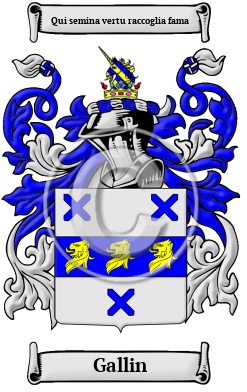
The motto was originally a war cry or slogan. Mottoes first began to be shown with arms in the 14th and 15th centuries, but were not in general use until the 17th century. Thus the oldest coats of arms generally do not include a motto. Mottoes seldom form part of the grant of arms: Under most heraldic authorities, a motto is an optional component of the coat of arms, and can be added to or changed at will; many families have chosen not to display a motto.
Motto: Qui semina vertu raccoglia fama
- Smith, Eldson Coles, New Dictionary of American Family Names New York: Harper & Row, 1956. Print
- Bardsley, C.W, A Dictionary of English and Welsh Surnames: With Special American Instances. Wiltshire: Heraldry Today, 1901. Print. (ISBN 0-900455-44-6)
- Lower, Mark Anthony, Patronymica Britannica, A Dictionary of Family Names of the United Kingdom. London: John Russel Smith, 1860. Print.
- Black, George F., The Surnames of Scotland Their Origin, Meaning and History. New York: New York Public Library, 1946. Print. (ISBN 0-87104-172-3)
- Smith, George (ed), Dictionary of National Biography. London: Smith, Elder & Co., 1885-1900. Print
- New Zealand Yesteryears Passenger Lists 1800 to 1900 (Retrieved 17th October 2018). Retrieved from http://www.yesteryears.co.nz/shipping/passlist.html
 |