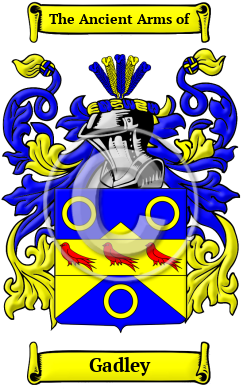
| ![Show Contents]() Gadley History, Family Crest & Coats of Arms Gadley History, Family Crest & Coats of Arms
- Origins Available:
England
Etymology of GadleyWhat does the name Gadley mean? The Anglo-Saxon name Gadley comes from the family having resided in Hadleigh or Hadley, a place-name found in numerous locations in England. The root of these names is common, however; they are all derived from the Old English roots hæth and leah, which taken together mean "forest clearing where the heather grows." 1 Early Origins of the Gadley familyThe surname Gadley was first found in Essex at Hadleigh, a parish, in the union and hundred of Rochford. 2 Over in Suffolk, Hadleigh was a market-town and parish, in the union and hundred of Cosford. "This town, which was probably founded during the heptarchy, about which period a monastery is said to have been established by one of the Saxon kings, was called by the Anglo-Saxons Headlege, whence it derived its modern name. Some of the kings of East Anglia were interred here; as also was Guthrum, or Gormo, a Danish chief, who submitted to Alfred the Great, and renounced paganism after the defeat of the Danes at the battle of Ethandune, now Eddington, in the county of Wilts: a tomb is still shown in the church as the monument of Guthrum (who died in 889)" 2 "In Essex and Suffolk I find two parishes of Hadleigh, and in Middlesex a parish Hadley." 3 Another source notes: "Hædleáh in an Anglo-Saxon will of the 10th century." 4 The first record of the family was indeed found in Suffolk. Matilda de Hadlega was listed there in the Pipe Rolls of 1194. Warin de Hadlai was listed in the Pipe Rolls of Yorkshire in 1212 and John Hadley was listed in the Feet of Fines for Essex in 1390. 5 Early History of the Gadley familyThis web page shows only a small excerpt of our Gadley research. Another 67 words (5 lines of text) covering the years 1194, 1379, 1682, 1685, 1691, 1730, 1731, 1744, 1749, 1753, 1756, 1760, 1763, 1764, 1768, 1771 and 1798 are included under the topic Early Gadley History in all our PDF Extended History products and printed products wherever possible. Gadley Spelling VariationsGadley has been spelled many different ways. Before English spelling became standardized over the last few hundred years, spelling variations in names were a common occurrence. As the English language changed in the Middle Ages, absorbing pieces of Latin and French, as well as other languages, the spelling of people's names also changed considerably, even over a single lifetime. Spelling variants included: Hadley, Hadleigh and others. Early Notables of the Gadley familyGeorge Hadley (1685-1768), an English lawyer and amateur meteorologist, eponym of the Hadley cell and The Met Office Hadley Centre for Climate Change John Hadley (1682-1744), was an English mathematician, inventor of the octant and precursor to the sextant around 1730. Mons Hadley and Rima Hadley on the Moon are named after him. He was the son of George Hadley, deputy-lieutenant and afterwards, in 1691, High Sheriff of Hertfordshire. "He must be distinguished from an older John Hadley who was also skilled in practical mechanics." 6 John Hadley MD (1731-1764), the Professor of chemistry at Cambridge, eldest son of Henry Hadley (brother of...
Another 123 words (9 lines of text) are included under the topic Early Gadley Notables in all our PDF Extended History products and printed products wherever possible. Migration of the Gadley familyIn an attempt to escape the chaos experienced in England, many English families boarded overcrowded and diseased ships sailing for the shores of North America and other British colonies. Those families hardy enough, and lucky enough, to make the passage intact were rewarded with land and a social environment less prone to religious and political persecution. Many of these families became important contributors to the young colonies in which they settled. Early immigration and passenger lists have documented some of the first Gadleys to arrive on North American shores: George Hadley settled in Salem Massachusetts in 1630; David and John Hadley settled in Virginia in 1772; Martha Hadley arrived in Maryland in 1736; Mrs. R. Hadley arrived in San Francisco with her child in 1860..
- Mills, A.D., Dictionary of English Place-Names. Oxford: Oxford University Press, 1991. Print. (ISBN 0-19-869156-4)
- Lewis, Samuel, A Topographical Dictionary of England. Institute of Historical Research, 1848, Print.
- Bardsley, C.W, A Dictionary of English and Welsh Surnames: With Special American Instances. Wiltshire: Heraldry Today, 1901. Print. (ISBN 0-900455-44-6)
- Harrison, Henry, Surnames of the United Kingdom: A Concise Etymological Dictionary Baltimore: Geneological Publishing Company, 2013. Print
- Reaney, P.H and R.M. Wilson, A Dictionary of English Surnames. London: Routledge, 1991. Print. (ISBN 0-415-05737-X)
- Smith, George (ed), Dictionary of National Biography. London: Smith, Elder & Co., 1885-1900. Print
 |