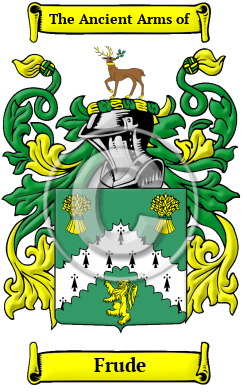
| ![Show Contents]() Frude History, Family Crest & Coats of Arms Frude History, Family Crest & Coats of Arms
Early Origins of the Frude familyThe surname Frude was first found in Devon, where Richard and Siward Frode were listed in the Pipe Rolls of 1184. 1 The Domesday Book has an entry for Frodo liber homo, who was living at Bury St. Edmunds, and whose son is documented as Gilbert filius Frodonis or Fit-Froude. 2 Hugh filius Frodonis was also listed at Bury St. Edmunds, Suffolk 1121-1148. William Froud was listed in Cheshire c. 1203 and later William le Frode was listed in the Subsidy Rolls for Kent in 1334. 1 Early History of the Frude familyThis web page shows only a small excerpt of our Frude research. Another 81 words (6 lines of text) covering the years 1184, 1187, 1203, 1334, 1525, 1664, 1665, 1667, 1678, 1688, 1718, 1719, 1738, 1772, 1776, 1778, 1779 and 1835 are included under the topic Early Frude History in all our PDF Extended History products and printed products wherever possible. Frude Spelling VariationsMultitudes of spelling variations are a hallmark of Anglo Norman names. Most of these names evolved in the 11th and 12th century, in the time after the Normans introduced their own Norman French language into a country where Old and Middle English had no spelling rules and the languages of the court were French and Latin. To make matters worse, medieval scribes spelled words according to sound, so names frequently appeared differently in the various documents in which they were recorded. The name was spelled Froud, Froude, Frowd, Frowde, Frude, Frood and others. Early Notables of the Frude familySir Phillip Froude, who is mentioned in the House of Commons Journal of February, 1667 as being "intrusted with the Management of the Post Office." Another source indirectly confirms this latter claim when Philip Frowde (d. 1738), the English poet, "was the son of Philip Frowde, deputy postmaster-general from 1678 to 1688. His grandfather, Colonel Philip Frowde, for his faithful adherence to Charles I and Charles II was knighted on 10 March 1664-1665 (Le Neve, Knights, Harl. Soc., p. 190), and...
Another 80 words (6 lines of text) are included under the topic Early Frude Notables in all our PDF Extended History products and printed products wherever possible.
| Frude migration to New Zealand | + |
Emigration to New Zealand followed in the footsteps of the European explorers, such as Captain Cook (1769-70): first came sealers, whalers, missionaries, and traders. By 1838, the British New Zealand Company had begun buying land from the Maori tribes, and selling it to settlers, and, after the Treaty of Waitangi in 1840, many British families set out on the arduous six month journey from Britain to Aotearoa to start a new life. Early immigrants include: Frude Settlers in New Zealand in the 19th Century- "Mr. James Frude, aged 39, British farm labourer who sailed from Plymouth, England to Lyttleton, New Zealand aboard the ship "Stonehouse" in June 1874
- "Mrs. Matilda Frude, aged 37, British settler who sailed from Plymouth, England to Lyttleton, New Zealand aboard the ship "Stonehouse" in June 1874
- "Miss Emily J. Frude, aged 12, British settler who sailed from Plymouth, England to Lyttleton, New Zealand aboard the ship "Stonehouse" in June 1874
- "Miss Angelina Frude, aged 1, British settler who sailed from Plymouth, England to Lyttleton, New Zealand aboard the ship "Stonehouse" in June 1874
- Reaney, P.H and R.M. Wilson, A Dictionary of English Surnames. London: Routledge, 1991. Print. (ISBN 0-415-05737-X)
- Williams, Dr Ann. And G.H. Martin, Eds., Domesday Book A Complete Translation. London: Penguin, 1992. Print. (ISBN 0-141-00523-8)
 |