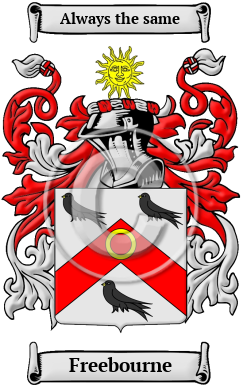
| ![Show Contents]() Freebourne History, Family Crest & Coats of Arms Freebourne History, Family Crest & Coats of Arms
Etymology of FreebourneWhat does the name Freebourne mean? The name Freebourne has a rich and ancient history. It is an Anglo-Saxon name that was originally derived from the baptismal name Frebern. Baptismal names began to appear as surnames relatively late in the growth of the naming tradition. This is a little surprising, given the popularity of biblical figures in the Christian countries of Europe. Nevertheless, surnames derived from baptismal names grew in popularity during the Middle Ages, and have become one of the foremost sources for surnames. Early Origins of the Freebourne familyThe surname Freebourne was first found in Berwickshire where they held a family seat from very ancient times, some say well before the Norman Conquest and the arrival of Duke William at Hastings in 1066 A.D. Early History of the Freebourne familyThis web page shows only a small excerpt of our Freebourne research. Another 71 words (5 lines of text) covering the years 1086, 1150, 1190 and 1890 are included under the topic Early Freebourne History in all our PDF Extended History products and printed products wherever possible. Freebourne Spelling VariationsBefore English spelling was standardized a few hundred years ago, spelling variations of names were a common occurrence. Elements of Latin, French and other languages became incorporated into English through the Middle Ages, and name spellings changed even among the literate. The variations of the surname Freebourne include Freebairn, Freeborn, Freebourn, Freebourne, Freeborne, Freeburn, Frebern, Freebern and many more. Early Notables of the Freebourne familyMore information is included under the topic Early Freebourne Notables in all our PDF Extended History products and printed products wherever possible. Migration of the Freebourne family to IrelandSome of the Freebourne family moved to Ireland, but this topic is not covered in this excerpt.
Another 77 words (6 lines of text) about their life in Ireland is included in all our PDF Extended History products and printed products wherever possible.
| Freebourne migration to the United States | + |
A great wave of immigration to the New World was the result of the enormous political and religious disarray that struck England at that time. Families left for the New World in extremely large numbers. The long journey was the end of many immigrants and many more arrived sick and starving. Still, those who made it were rewarded with an opportunity far greater than they had known at home in England. These emigrant families went on to make significant contributions to these emerging colonies in which they settled. Some of the first North American settlers carried this name or one of its variants:
Freebourne Settlers in United States in the 17th Century- Mary Freebourne, aged 7, who arrived in New England in 1634 1
- Sarah Freebourne, aged 2, who landed in New England in 1634 1
- William Freebourne, who arrived in New England in 1634 1
| Freebourne migration to New Zealand | + |
Emigration to New Zealand followed in the footsteps of the European explorers, such as Captain Cook (1769-70): first came sealers, whalers, missionaries, and traders. By 1838, the British New Zealand Company had begun buying land from the Maori tribes, and selling it to settlers, and, after the Treaty of Waitangi in 1840, many British families set out on the arduous six month journey from Britain to Aotearoa to start a new life. Early immigrants include: Freebourne Settlers in New Zealand in the 19th Century- Ann Freebourne, aged 21, a housemaid, who arrived in Wellington, New Zealand aboard the ship "Collingwood" in 1875
The motto was originally a war cry or slogan. Mottoes first began to be shown with arms in the 14th and 15th centuries, but were not in general use until the 17th century. Thus the oldest coats of arms generally do not include a motto. Mottoes seldom form part of the grant of arms: Under most heraldic authorities, a motto is an optional component of the coat of arms, and can be added to or changed at will; many families have chosen not to display a motto.
Motto: Always the same
- Filby, P. William, Meyer, Mary K., Passenger and immigration lists index : a guide to published arrival records of about 500,000 passengers who came to the United States and Canada in the seventeenth, eighteenth, and nineteenth centuries. 1982-1985 Cumulated Supplements in Four Volumes Detroit, Mich. : Gale Research Co., 1985, Print (ISBN 0-8103-1795-8)
 |